
Throwback Thursday - Behind the Scenes (NYPD Intelligence)

Readers of my books know that I reference a lot of different places and agencies. Many of them are part of the backstory for my characters, so I thought I would start something new called: Throwback Thursday.

From time to time I will present you with a brief history of one of the units or locations I write about, to help you get a better understanding of the character’s story.  Today’s Throwback Thursday post pertains to something near and dear to my heart: NYPD intelligence.

In Perfect Pawn, readers are introduced to retired NYPD Detective James Maguire. For a period of time he was assigned to the NYPD’s Intelligence Division (now known as the Intelligence Bureau). What many do not know is that the command’s roots can be traced back to Lieutenant Giuseppe ‘Joe’ Petrosino and the Italian Squad. Lt. Petrosino was instrumental in pursuing the organized crime group known as the ‘Black Hand.’ Petrosino was killed while investigating the group in Palermo, Sicily.

It would be nearly fifty more years till the Intelligence Division would be tasked with providing dignitary protection, but in an ironic twist, during his infiltration of an Italian anarchist group, Petrosino uncovered a plot to assassinate then President William McKinley. Petrosino alerted the Secret Service, but the President ignored the warning, even after then Vice-President Theodore Roosevelt, who had been an NYPD Commissioner, vouched for Petrosino and his abilities. As warned, the group followed through and McKinley was assassinated during his visit to the Pan-American Exposition in Buffalo on September 6, 1901.

Following Petrosino’s own assignation, by the Black Hand in 1909, Acting Detective Sergeant Charles Corrao took over the Italian Squad. At that time the city was dealing with a string of attacks with explosives, as the Black Hand had now begun to use bombs as a means of extortion.  On one occasion Corrao grabbed a bomb from Black Hand member Giovanni Rizzo’s hand and defused it while the man fled. After a subsequent chase, and an exchange of gunfire between the two, Rizzo was captured.  For his actions, Charles Corrao was awarded the newly adopted NYPD Medal of Honor and the Rhinelander Medal for Valor on May 18, 1912. The NYPD’s Bomb Squad has its foundation in these early bomb investigations.

As the years progressed, the role of the Intelligence Bureau would adapt and expand. What started with investigating Italian organized crime (the Black Hand Squad) soon included communist activities (the Red Hand Squad). The Red Squad then became known as the Bureau of Special Services and Investigations (BOSSI), which was focused on domestic groups like the Black Panther Party, Weather Underground and the Students for a Democratic Society. Along the way, they picked up the dignitary protection assignment. In the early 70’s BOSSI was reorganized and retitled the Intelligence Division. Following the September 11th Terror Attacks it was expanded to a global unit and renamed the Intelligence Bureau.

My time in the Intelligence Division was an incredible part of my career with the NYPD, so it is only fair that it also plays a pivotal part in the character of Maguire. I’ve stood next to presidents, the Pope, and more foreign and domestic dignitaries than I can count. I’ve ridden in motorcades and I’ve watched them with a birds-eye-view from helicopters. It is simultaneously exhilarating and nerve-wracking. One of the things you learn quickly is to never be complacent.

One story that drove that point home rather quickly occurred back around 1995/6. The Israeli Prime Minister, Shimon Peres, was traveling in his motorcade. At the time, because of the elevated threat risk, the Israeli PM got what amounted to a Vice-Presidential level motorcade package.

At the last minute we got word that a decision had been made to take the secondary route, which involved the Belt Parkway.  I was assigned to huntsman, the helicopter which provides aerial surveillance along the motorcade route, and things were going along quiet well; at least until the thought occurred to me that traffic was really, really light coming from the opposite direction…… Anyone who has spent 15 minutes in New York City can tell you that traffic is never light.

I instructed the motorcade to slow down and told the pilot to head forward to see what was causing the delay. My initial thought was a motor vehicle accident, which would bring the motorcade to a halt unless we got a lane cleared. My fears were surpassed when I gazed out the front window of the helo and saw that the Mill Basin drawbridge was in the upright position as a large vessel lazily made its way in from the Atlantic Ocean.

Oops.

This resulted in an immediate frenzy of colorful communication between me and my USSS counterpart, as we tried to get the motorcade to come to an almost screeching halt. I will never forget the sight of the motorcycle officers, from the Highway Patrol, racing up to the drawbridge to get them to drop it back down in place.  How we managed to unscrew that one in time, remains a mystery, but we did. The motorcade never stopped moving and I don’t remember ever using the Belt Parkway for as long as I was in the Division.

In Chapter Five of Perfect Pawn I provide the reader a glimpse into the world of presidential protection. For many, it is the closest they will ever get to being inside the bubble. It was from this period of time in my career that I drew on inspiration for not only the role of Maguire, but his friend, Rich Stargold, who is a composite of some of the people I worked with in the Secret Service.

Someone once asked me if I missed it and my answer is: Yes, every single day.

Please remember to sign-up for my FREE monthly Newsletter to stay up to date on the latest information.

72 Poplar Street, Brooklyn, NY (Former home of the Intelligence Division) - Author Photo

72 Poplar Street, Brooklyn, NY (Former home of the Intelligence Division) - Author Photo

Challenges for Writers: Slip-Sliding Down The Rabbit Hole

In his book, Alice's Adventures in Wonderland, author Lewis Carroll was kind enough to provide the perfect metaphor for us as writers.

If you are like me, it can sometimes feel that we are tumbling head-over-heels down a Rabbit Hole in the pursuit of our chosen profession.  The casual reader (along with your family and friends) has a skewed sense of what it actually means to be a writer. They see folks like James Patterson, J.D. Robb and Lee Child and think that we all fall into that category, but that’s like comparing someone who plays for the New York Yankees with a Double A player on the Trenton Thunder.

The harsh reality is that the role of an indie author is much more complicated.

As an up & coming author, you need to realize that your ‘work’ does not end with the final draft of your book. In fact, it is only the beginning and there will come a point in time when you look back fondly on the writing phase as being the fun part.  As of this post, I have authored a total of ten books, along with two novellas, and I am currently working on my latest work-in-progress. You would think that I would have a firm grasp of the publishing process, but you’d be wrong.  I learn new things pretty much on a daily basis; which I guess is a lot better than not learning.

For someone just starting out you need to face the fact that, unlike the authors listed above, you probably do not have access to publishing resources, meaning: Tag, You’re it. When addressing this issue, you have two choices: 1) Pay someone to do it, or 2) Do it yourself. Personally, I opted for the latter, because I have always been a hands-on person, but that does not mean it will always work. You have to know your limitations.

Your first concern, upon completing what you believe is the final draft of your book, is to get it edited. I know, I know, you’re sitting there going: “I took AP English, I’m good.”  - No, you’re not.

There is a lot more that goes into the editing process than just grammar. Authors wear one hat, editors wear a different one. We create stories in our mind, which we think we translate well onto paper, but sometimes we forget to add some of the details. An editor will go through and pick that up, because they don’t have the backstory floating around in their heads. If they have questions then the reader will be left with questions, and that only works in cliff-hangers, not the middle of your story. If you do not know someone who can help, then this might be an area where you want to pay, but be prepared for sticker shock: Grammar Nazis are not cheap.

Beyond the text, one of the critical parts of a book, that is often underappreciated, is formatting it. Simply put, people expect your book to look like any other book produced by a legacy publishing house.  Take the time to learn how to format correctly. If you want to be a professional writer, your book has to look like it was professionally written. Go to your library (ever writer should have one in their home) and peruse the interiors.  Make sure you learn how to emulate what you see. If you want to be the next James Patterson, ensure that your book is on the same level as his.

Consider the writing process like mowing the grass. Most anyone can take a patch of rich soil, sprinkle some seeds on it, water it and grow a pretty nice, grassy field. But if you don’t maintain it, it will end up looking like crap. The more upkeep you do, the better it looks and the more it will be appreciated.

Cover Art is another critical area that is often overlooked. There is an old saying that goes, “You only have one opportunity to make a good first impression.” You could have someone create an amazing cover, but when you shrink it down to thumbnail size, which is what most of your potential readers are going to see, it looks like an undefined blob. Conversely, I have seen some folks who grab the first ‘clip-art’ image they can get, slap it on the cover and think, “I’m done.” – Well, in a way you’re right and so is your book.

There are several critical things to consider:

1.       Is it appealing looking to the audience?

2.       Does it correspond to the plot of your book?

3.       Can you see the title clearly?

4.       Can you see your name clearly?

5.       Does it look cartoonish?

 Whether you agree or not, the truth is that people do judge a book by its cover. You could have written the next Hunt for Red October, but if your cover looks like it was put together by an 8th grader for art class, the odds are pretty good that a potential reader is not going to be willing to plunk down their hard earned cash just to give you a chance. You have to make them want to buy your book instead of that best-selling author’s book.

Remember, you’re a combatant in the ‘thumbnail wars’ so fight accordingly.

When I wrote my first book, Perfect Pawn, I thought I had nailed it on the first go-round, but as time went on I began to rethink that. Over the years I had grown in experience; so I went back and made alterations to not only the text, but to the cover as well.

Bottom line: Don’t be afraid to re-evaluate things from time to time.

Coming Up Next: REVIEWS.

That is, after all, what we should be focusing on after we launch our books. If you are not driven to be a best-selling author, then ignore everything you have just read, because it really doesn’t matter. Write your book, publish it, and walk away. But, if you are like me, and do want your book to appear on the NY Times Best-Selling List, then you have to be prepared to do the heavy lifting.

Next week I will be discussing some of the things you can do to boost your sales.

Please remember to sign-up for my FREE monthly Newsletter to stay up to date on the latest information.

Where Was God ? Update (1st Qtr Royalty Donation)

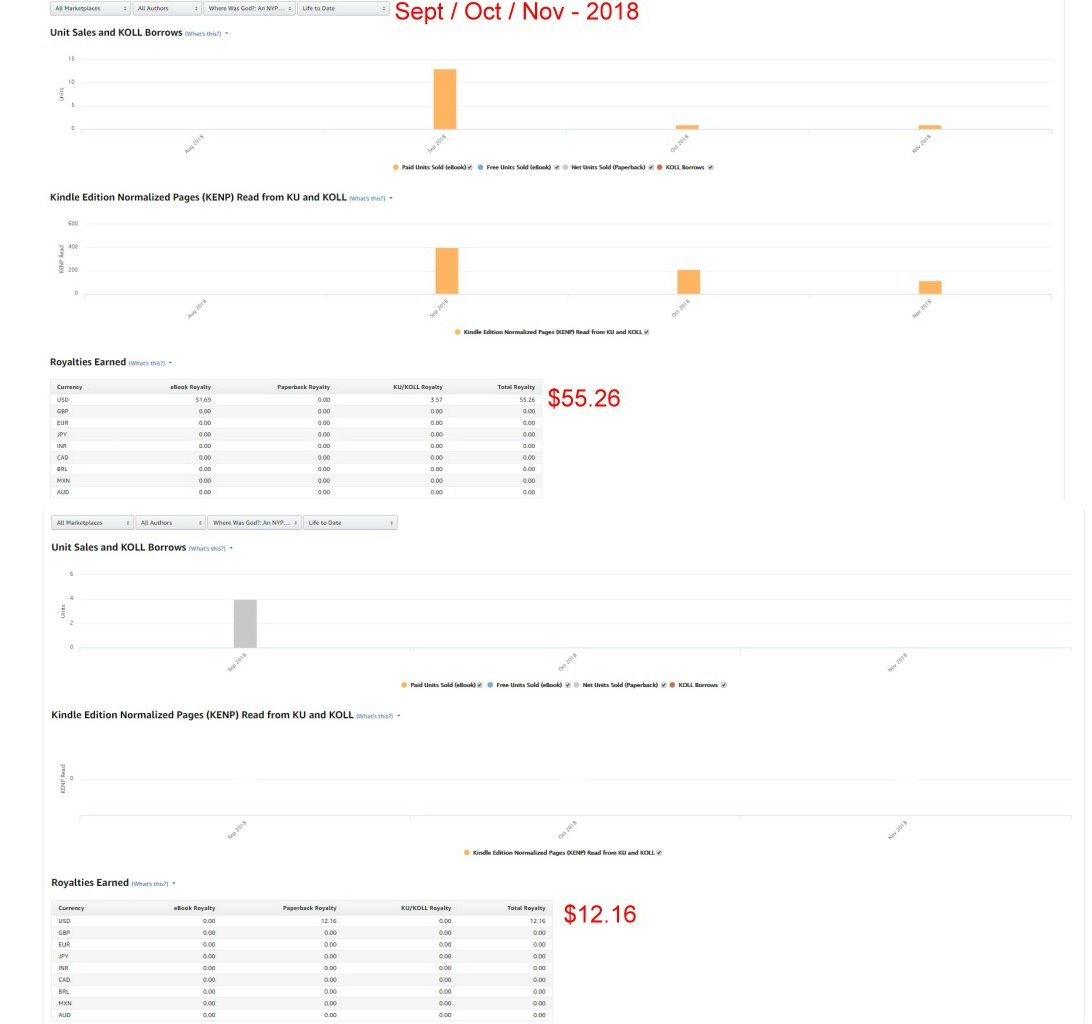
Pleased to announce that the numbers are in for the first quarter sales of Where Was God ? and, as promised, we are donating all royalties to charity. Today I was able to sign a check for one hundred dollars to the Salvation Army. It is nice to see that even seventeen years later we can still make something good come out of that tragedy.

Of course, none of this is possible without the reader. If you haven’t read the book yet, please consider it and also share the link with friends. So many people are searching for answers and I think that once you open it you will find some. As one reader put it, “Early in my journey with God I read ‘The Case for Christ’ [Strobel] and I was disappointed. It was not persuasive and frankly left more food for the cynic in me. Your book felt like a real case for Christ, as if a seasoned trial lawyer was putting on a case.”

Please remember to sign-up for my FREE monthly Newsletter to stay up to date on the latest information.

WWG_Royalties_002.jpg
WWG_1st_Qtr_Royalties.jpg

Interview: INFOWIND News

I had the opportunity to sit down and have a chat with Chip Peterson over at INFOWIND News. We discussed a number of things including my career with the NYPD, my response to the September 11th terror attack at the World Trade Center, politics and my career as an author. I hope you enjoy it.


September 11th – Yes, they have FORGOTTEN

Update – I wish I didn’t have to write this update, but I do.

As a mystery author, I often include salacious political twists in my storylines, but I am finding that sometimes art doesn’t come close to matching the twisted machinations of what goes on in the back rooms of Washington, D.C.

Back in October 2018, I wrote a post titled: NEVER FORGET THE HEROES. It dealt with the need of Congress to address the 9/11 Victim Compensation Fund Act (S. 3591 / H.R. 7062), which is scheduled to run out of money in 2020.

If you are like me, you have to wonder why programs such as this are always facing financial peril, yet we never seem to run out of money to fund pressing issues like spending $15 million to study the effectiveness of golf equipment in space or a $43 million gas station in Afghanistan.  Hell, I recall reading one report where the Department of Defense purchased, and then left unused, approximately 270,000 commercial airline tickets at a total cost of $100 million. To compound the problem, the bean-counters over at the Pentagon never bothered to get a refund for the fully refundable tickets. Of course they didn’t and why should they? It is a clear case of: OPM – Other People’s Money, namely YOURS.

If Americans spent just one afternoon casually perusing the voluminous articles there are on wasteful congressional (and overall governmental) spending, Washington D.C. would be a charred, barren wasteland by morning. Yet, when it comes to funding a bill that would provide compensation and medical coverage for the victims of the deadliest terror attack in United States history, the congress seems to have a really hard time trying to find the money. But how much money are we talking about?

Well, the last re-authorization of the bill, in 2015, allocated just under $5 billion to fund it till 2020. Now, this might sound like a lot of money, and it is, except for when you consider some other interesting spending  facts. In 2016, the last full fiscal year analyzed, the Congressional Research Service (CRS) determined that the United States provided roughly $49 billion in foreign aid. So in just one year we provided nearly 10x the funding to foreign nations than we allocated to caring for our sick and dying first responders.  Yet even this staggering amount of $49 billion in foreign aid still only accounted for about 1.2 percent of the total annual federal budget.

If you think this is bad, consider the following.

Afghanistan, the country from where 9/11 mastermind Osama Bin Laden orchestrated the terror attacks has received the following funding since 2001:

2001 - $92 million

2002 – $508 million

2003 – $984 million

2004 – $1.9 billion

2005 – $1.7 billion

2006 – $3.4 billion

2007 – $4.9 billion

2008 – $8.3 billion

2009 – $8.6 billion

2010 – $7.8 billion

2011 – $11 billion

2012 – $10 billion

2013 – $10 billion

2014 – $7.1 billion

2015 – $9.1 billion

2016 – $4.2 billion

2017 – $4.9 billion

(Source: USAID https://explorer.usaid.gov/cd/AFG disbursements)

For those mathematically inclined, that is nearly $100 billion in funding to the very same country from which the attack was planned. Now you can see why many of the victims feel as if we are being left alone to die. Victims have to beg for funding while money is being thrown hand over fist at our attacker. Hell, we even have to BEG for support from our own elected representatives; which brings me right back to my original post.

In October 2018, I reached out to my congressional representative, Rodney Davis (R-IL), through his official government website and asked him to co-sponsor H.R. 7062. It seemed like a no-brainer to me, since he actually represents a first responder who was directly impacted by the attack. I contacted him and I waited…… and I waited. In the three months since, my wife has contacted his office twice and received correspondence from his office.

Me? Not so much.

I guess an NYPD 9/11 survivor with cancer doesn’t merit a stamp.

Perhaps I am better off. The form-letter version I received from him, the last time around, pretty much made my blood boil.

Rodney has spoken out in the past about the attack, but, just like other politicians, he only seems to #NeverForget when the cameras are rolling. Unfortunately, I #REMEMBER every single day. Something else I will remember is Election Day 2020 and I will do my utmost, to remind everyone I know in the 13th Congressional District, to send a message to Rep. Davis. In fact, I still have a few local reporters on my speed-dial and I am sure they would love to do a timely piece.

To find out if your elected representatives have supported 9/11 victims, please visit the following link:

http://www.renew911health.org/take-action/take-action-contact-your-members-of-congress/

Remember to sign-up for my FREE monthly Newsletter to stay up to date on the latest information.