Publication Day: Exposed King

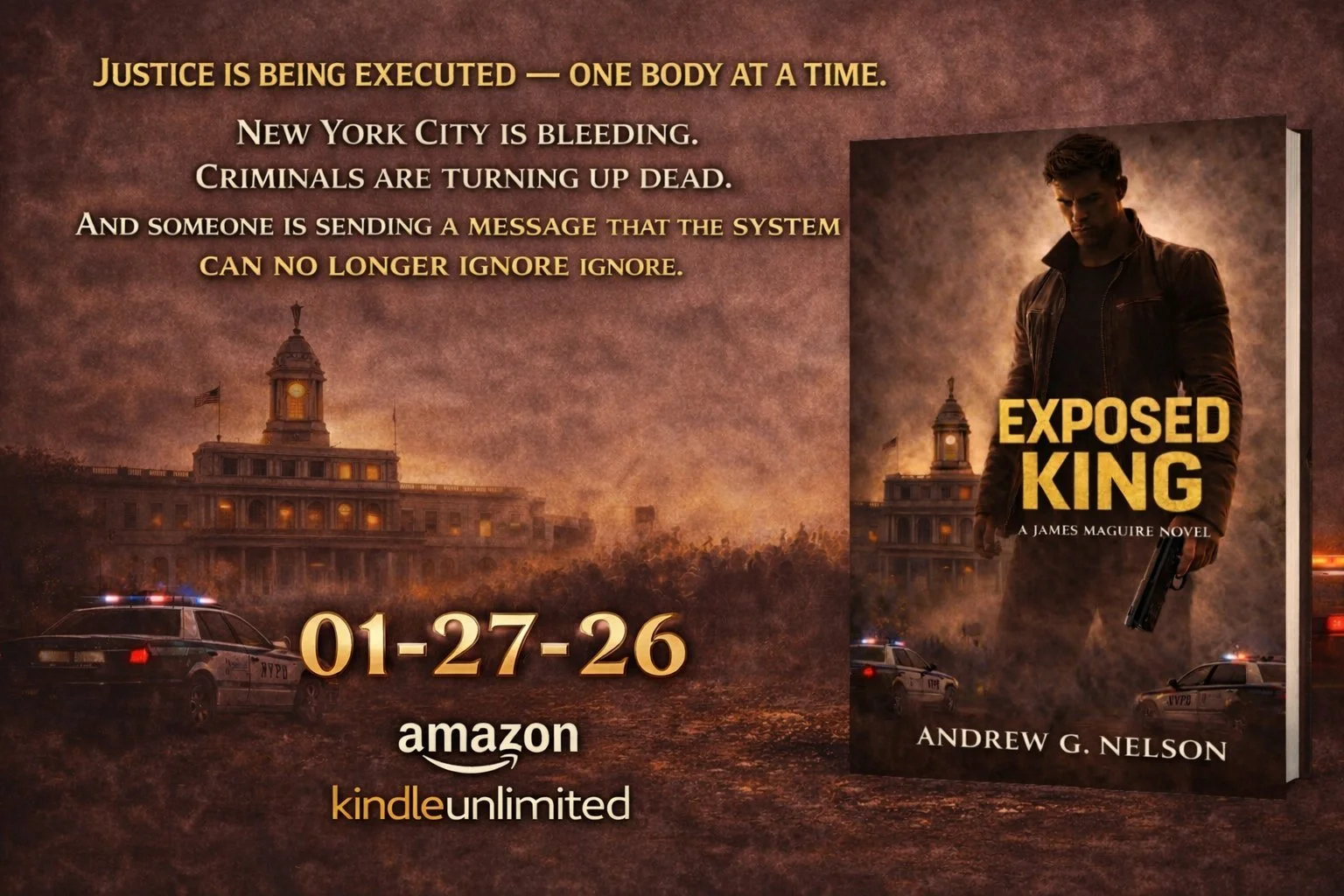
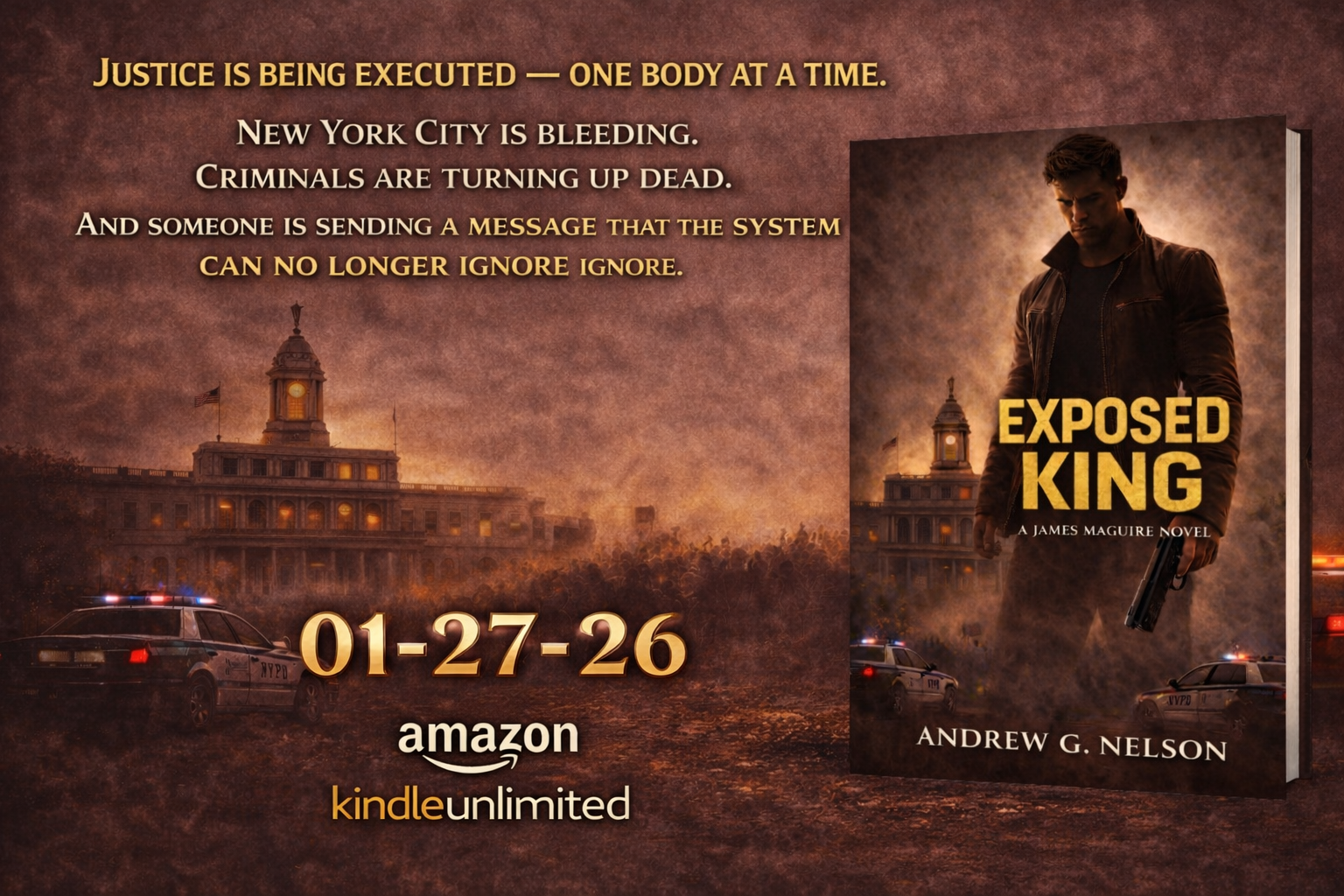
Today is publication day for Exposed King.

This novel has been a long time coming. What began as a crime thriller about a city under pressure evolved into a story that feels uncomfortably close to the world we’re living in now—where trust is fragile, power is protected, and justice is anything but simple.

Exposed King follows NYPD Commissioner James Maguire as New York City spirals. Criminals are turning up dead, fear is spreading, and someone is sending a message that the system can no longer ignore. As the lines between right and wrong blur, Maguire is forced to confront a question with no easy answer:
What happens when justice stops working?

The book is now live on Amazon Kindle, and I’m incredibly grateful to everyone who’s supported the James Maguire series along the way.

Thank you for reading.
The story is officially yours.

Pick up your copy of Expose King on Amazon today.

— Andrew G. Nelson

Exposed King Is Now Available for Kindle Pre-Order

I’m excited to announce that Exposed King, the next novel in the James Maguire series, is now available for pre-order on Amazon Kindle.

This story follows NYPD Commissioner James Maguire as New York City begins to unravel. Criminals are turning up dead. Fear is spreading. And somewhere in the chaos, someone is making it clear that the system no longer works the way it’s supposed to.

As pressure mounts, Maguire is forced to confront not just a growing body count, but the uncomfortable reality that justice—when filtered through politics, power, and public anger—rarely remains clean.

Exposed King was written as a crime thriller, but at its core it’s a question:
What happens when trust in the system collapses, and people decide the rules no longer apply?

If you enjoy gritty NYPD procedurals, morally complex characters, and stories that feel uncomfortably close to the real world, this one was written for you.

The Kindle edition is now live for pre-order on Amazon, with release coming soon.

Thank you to everyone who’s followed the James Maguire series so far. I can’t wait to put this one in your hands.

— Andrew G. Nelson

Cover Reveal: EXPOSED KING

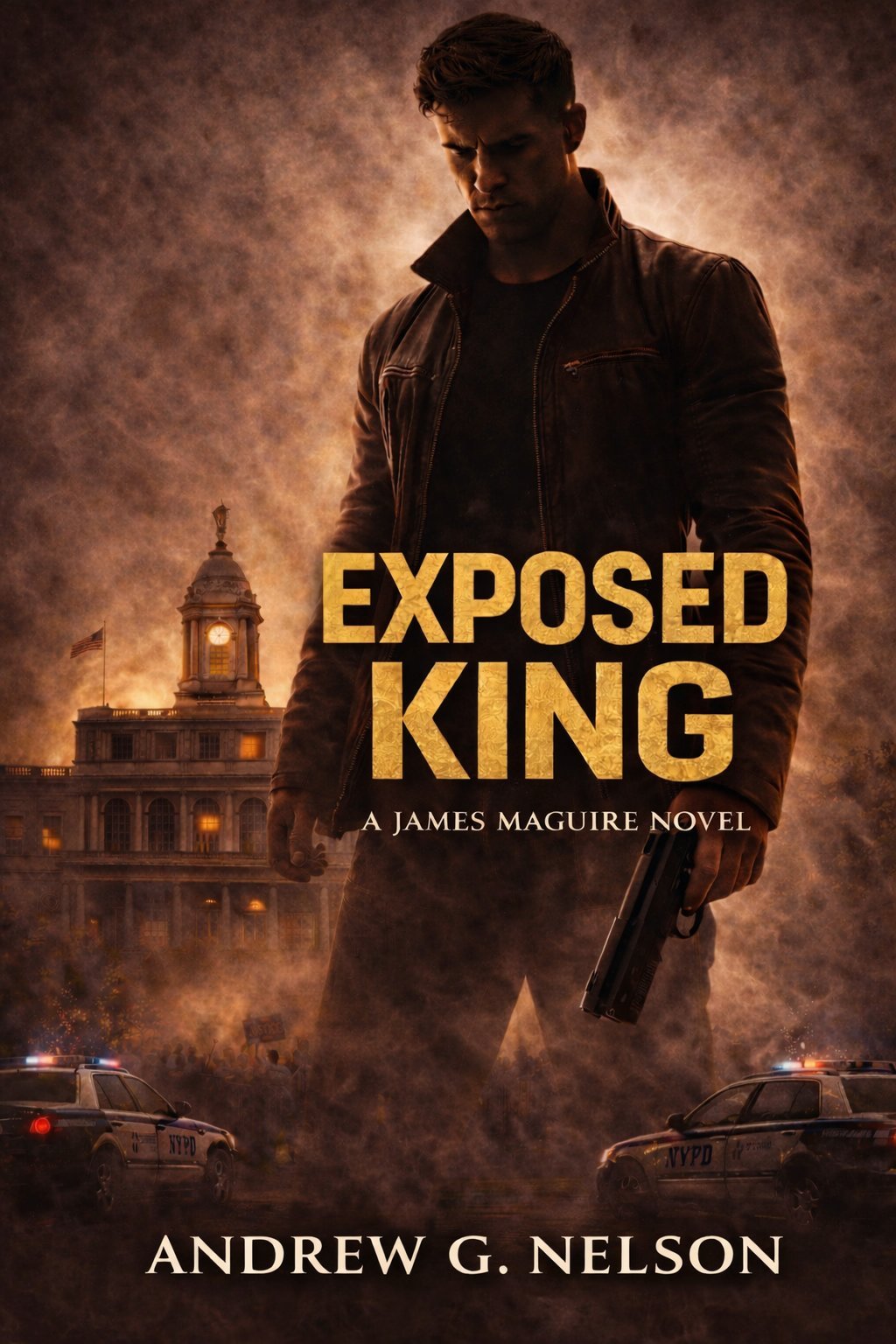
Today, I’m excited to officially reveal the cover for Exposed King, the next James Maguire novel.

I didn’t set out to write a book that mirrored the moment we’re living in—but sometimes fiction gets there first. Exposed King explores what happens when justice fractures, trust collapses, and a city is pushed to the edge. Today, I’m revealing the cover.

From the beginning, this story has been about pressure—on a city, on the justice system, and on the people sworn to uphold it. The cover reflects that tension: a city on edge, authority under siege, and a single figure standing at the center of it all.

Exposed King asks a simple but uncomfortable question: What happens when the system stops working—and people decide to take justice into their own hands?

This book was written before many of the events we’re witnessing now, but like the best crime fiction, it explores forces that never really go away: power, anger, corruption, and the consequences of pushing society too far.

The story is coming soon.
And so is the reckoning.

The System Isn’t Broken — It’s Working as Designed

Recent events have once again exposed a dangerous game being played by those in power. A familiar pattern repeats itself: politicians pander to a base they know will not question narratives, will not dig into history, and will not examine the mechanics of government. Emotion is rewarded. Outrage is amplified. Nuance is punished.

And the consequences are never borne by the people making the speeches.

Laws, Blame, and Convenient Amnesia

Here’s an uncomfortable truth that rarely gets said plainly enough: Politicians write the laws. Law enforcement enforces them.

The legislative branch creates policy. The executive branch carries it out. That division is foundational to how our system is supposed to function. But when laws become politically inconvenient—when enforcement generates backlash—the same politicians who authored those laws suddenly develop amnesia.

Instead of revisiting bad policy or owning the consequences of their votes, they deflect. They point to “rogue officers.” They vilify the very people tasked with enforcing statutes that lawmakers themselves passed, funded, and defended.

It’s a neat trick: create the problem, then redirect the anger toward the most visible uniform in the room.

Power Preserved, Lives Spent

At the local level, this dynamic becomes even more dangerous. City councils, mayors, and prosecutors gin up public anger, knowing full well they will never stand between that anger and its consequences. They speak recklessly from behind microphones while officers are sent into the streets to absorb the fallout.

Those officers are not policymakers. They are employees—hired to do a job, bound by oath, procedure, and law. Yet they find themselves caught in the crosshairs: politically expendable, publicly condemned, and personally threatened for doing precisely what they were ordered to do.

Power is preserved. Lives are risked. And the gap between rhetoric and reality grows wider.

Selective Memory and Political Shape-Shifting

What makes this moment especially corrosive is the sheer audacity of the flip-flopping.

We are told today that certain policies are “fascist” or “authoritarian,” despite being openly supported—sometimes enthusiastically—by the very same political figures in previous years. Calls for stricter immigration enforcement once framed as pragmatic governance are now recast as moral atrocities. Policies once defended as necessary are retroactively condemned when they become politically inconvenient.

We are asked to believe two contradictory things at once: that enforcement is tyranny, and that the people who enforced it before were heroes.

This isn’t moral growth. It’s political shape-shifting.

When Law Enforcement Becomes the Enemy

There is a line—an old one, and a dangerous one—that societies cross when law enforcement is successfully reframed as “the enemy of the people.” When that happens, anarchy doesn’t arrive all at once. It creeps in slowly, justified as righteous anger, tolerated as political expression, excused as necessary pressure.

But here is the part no one in the crowd is meant to think about:

Once protests outlive their usefulness…
Once the anger reaches critical mass…
Once it threatens the same politicians who encouraged it…

The switch flips.

The same law enforcement once vilified becomes indispensable again. The same laws once condemned are suddenly enforced with urgency. And the same people who were cheered on in the streets find themselves facing the full weight of the system they were told no longer applied.

History is very clear on this point.

Why I Wrote Exposed King

These themes sit at the heart of my upcoming novel, Exposed King. What begins as a crime story quickly becomes something more unsettling: a portrait of a city where politics paralyze justice, where leaders hide behind ideology, and where the consequences of that cowardice begin to surface in blood.

The book isn’t an endorsement of chaos or vigilantism. It’s a warning about trajectories—about what happens when leaders stop governing and start posturing, when enforcement becomes a political liability instead of a civic necessity, and when responsibility is endlessly deferred.

Because when the system teaches people that laws are optional, enforcement is immoral, and accountability is selective, it shouldn’t be surprised when someone decides the rules no longer matter.

And by then, it’s already too late.

A Government of Laws, Not of Men

One of the most dangerous shifts in modern governance isn’t happening loudly. It isn’t announced with sweeping legislation or dramatic court rulings. It’s happening quietly, through omission, selective enforcement, and political posturing by those entrusted to uphold the law—not reinterpret it.

At the center of this shift is a troubling trend: senior law enforcement executives increasingly engaging in political activism rather than enforcement.

The Unique Weight of the Badge at the Top

Unlike many political appointments, the selection of a chief law enforcement officer—police commissioner, chief, sheriff, or attorney general—carries a responsibility that transcends ideology. These roles are not meant to advance political agendas or signal virtue to a partisan base. They exist for one reason: to faithfully and impartially enforce the law as written.

That doesn’t mean leaders can’t hold personal views. It means those views must never eclipse their obligation to the rule of law.

And yet that is exactly what we are seeing happening across the country. In cities like Los Angeles, Portland, Minneapolis, Chicago, Philadelphia, D.C. and New York City, we are watching senior law enforcement executives quietly abandon the oath they swore to uphold the Constitution. Instead of faithfully executing the duties of their office, too many have chosen self-preservation—submitting to the political whims of mayors, governors, and party power brokers in order to keep their positions. In doing so, they trade principle for proximity to power, and the badge for a bargaining chip. The damage isn’t abstract: it erodes trust, confuses subordinates, and signals to the public that the rule of law is negotiable if one’s job depends on it.

When a law enforcement executive begins governing by personal belief, political loyalty, or public pressure instead of statute, the entire system begins to blur. The result is not compassion. It is confusion.

When Enforcement Becomes Optional

Laws are not suggestions. They are not talking points. And they are not meant to be selectively applied based on who agrees with them.

If a law is unjust, outdated, or harmful, there is a mechanism for addressing it: the legislature. Debate it. Amend it. Repeal it. That is how a republic functions.

What a society cannot survive is a system where governors, mayors, or law enforcement executives decide—unilaterally—which laws they feel like enforcing and which they don’t. That isn’t leadership. It’s circumvention.

And it sends a dangerous message to everyone watching:
If you don’t agree with a law, you don’t have to obey it.

The Damage Below the Surface

This ambiguity is corrosive, especially within the ranks of law enforcement.

Officers are hired to enforce laws, not guess political winds. When direction from the top becomes inconsistent—enforce this today, ignore it tomorrow, apologize for it publicly next week—it creates paralysis. Officers hesitate. Enforcement becomes uneven. Decision-making becomes reactive rather than principled.

That uncertainty doesn’t just affect morale. It affects safety.

At the same time, the public absorbs the lesson being taught. When enforcement appears arbitrary or politically motivated, compliance erodes. Boundaries blur. Tensions rise. And in that space—between unclear authority and emboldened defiance—catastrophic incidents are born.

Not because laws were enforced.
But because they weren’t enforced consistently.

Laws Belong in the Legislature, Not the Headlines

A society governed by laws cannot function if those laws are endlessly debated in the street instead of addressed in the chamber where they were created. Enforcement is not the place for policy experimentation. It is the final step in a process that should already be settled.

When enforcement becomes performative—applied or withheld to curry favor—it ceases to be justice. It becomes theater. And theater is a poor substitute for order.

The Principle at Stake

The phrase “a government of laws, not of men” exists for a reason. It is a warning against exactly this moment—against systems where personal ideology replaces institutional obligation, and where authority bends to personality instead of principle.

Once enforcement depends on who is in charge rather than what the law requires, the rule of law is no longer the foundation. It’s just another opinion.

And no society remains stable for long when the law itself becomes optional.

These tensions sit at the heart of my upcoming novel, Exposed King. In the story, NYPD Police Commissioner James Maguire finds himself trapped between a political system that helped create the chaos now gripping the city and a shadowy group that has decided the system is beyond repair—and that justice must be taken into their own hands. As laws are debated, undermined, and selectively enforced, Maguire is left to confront the consequences of leadership by ideology rather than principle. The novel isn’t an argument for vigilantism; it’s a warning about what emerges when the rule of law is weakened from above and abandoned from below.

Exposed King is coming soon.