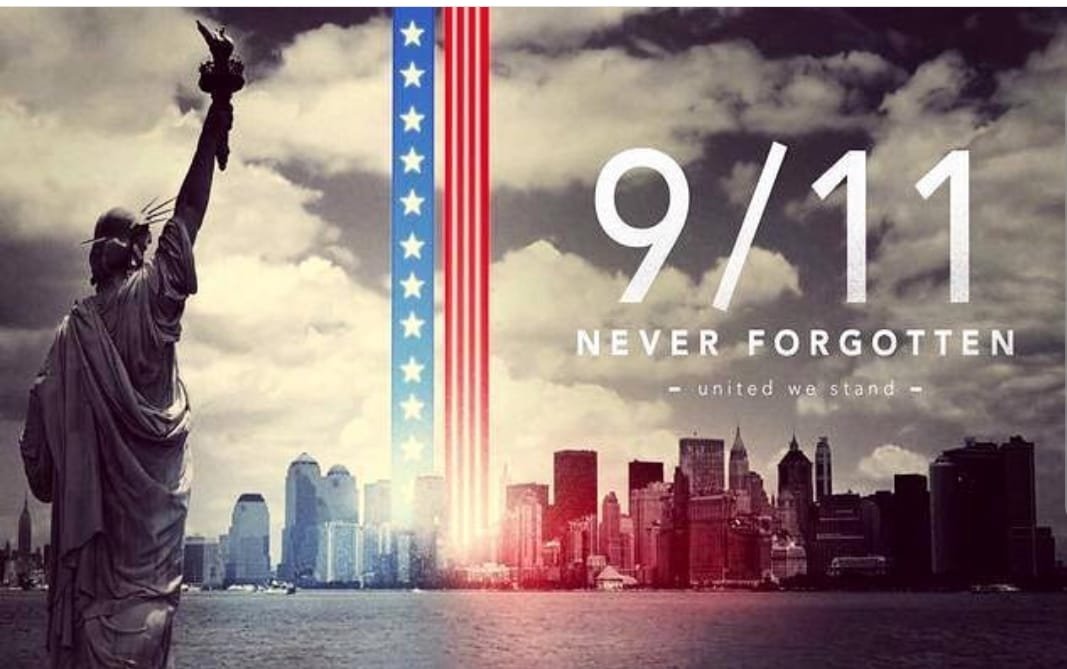
Twenty-Five Years Later: Where Was God on September 11th?

It truly is up to us to Never Forget the heroes and victims of September 11th, 2001. But the sad reality is that while the attacks happened twenty-five years ago, September 11th is still taking lives. The NYPD lost 23 members that day. In the years since, hundreds more members of the Department have died from 9/11-related illnesses, including my former partner, Lieutenant Paul Murphy, while thousands more continue to battle cancers and other serious conditions.

Across the entire 9/11 community, the toll is even greater. Thousands of responders and survivors have died in the years since, while tens of thousands continue to live with illnesses associated with their exposure.

Even those of us who survived the attack did not simply walk away from it.

September 11, 2001

That Tuesday morning was Primary Election Day in New York City. I was an NYPD sergeant working a day tour, visiting polling locations.

For me, it began as just another workday. That changed quickly.

The first report we heard was that there had been an explosion at the World Trade Center. My first thought was remarkably mundane: This is going to create absolute havoc with traffic.

As we were pulling up to a polling location, another call came over. A plane had struck the North Tower.

My mind immediately went to a small commuter aircraft or perhaps a sightseeing helicopter. Both were common sights along the Hudson and East Rivers. At that point, the idea that a commercial airliner had deliberately been flown into the World Trade Center was simply beyond comprehension.

Then came the report of the second plane. We knew we were under attack.

My driver took us to the Special Operations Division, where for the first time I was able to see the television coverage. Looking at those images, it became painfully apparent that these were not small aircraft.

I had quit smoking about a week earlier.

I called my wife and told her that I was “quitting quitting.”

I knew a cigarette shop nearby and had my driver stop. I ran inside for a pack and discovered that, of all things, they were out of my brand.

The clerk and I just stared at each other.

I could have bought something else, but for whatever reason, I didn't. I walked back outside almost as if I were trying to process this strange little inconvenience in the middle of everything happening around us.

My driver asked if we were ready to go.

“No,” I told him. “They're out of my brand.”

So we went somewhere else.

I got my cigarettes, and we immediately headed toward Manhattan.

During the drive, I called my wife again and told her where we were going.

She panicked.

“You can't go in,” she told me. “You don't have your vest.”

In one of those strangely funny moments that somehow occur even on the darkest of days, I replied: “They're flying planes into buildings. I don't think my vest is going to help me.”

We had only been married for a couple of years. For her, I think that moment brought a sudden realization of what being married to a police officer could mean.

Because this is what we do.

We run toward the danger, not away from it.

Going In

The drive toward Manhattan was difficult. Cars had been abandoned in the roadway, forcing us to weave around them and drive along the shoulders.

At one point the view ahead opened up and I could see the Twin Towers.

Black smoke billowed from them against an otherwise crystal-clear blue September sky.

When we reached the Brooklyn-Battery Tunnel, there was a firetruck stopped near the toll plaza. As we were about to pass it, a firefighter jumped out and stopped us.

Before I could really process what was happening, a wall of smoke and debris came pouring out of the tunnel.

Then came civilians.

They were running out, covered from head to toe in gray ash.

For a moment, I thought the tunnel itself had been attacked.

My mind was still focused on one thing: get to the World Trade Center.

I directed my driver toward the Brooklyn Bridge instead.

By the time we got there, we encountered an enormous mass of people trying to get out of Manhattan. It quickly became obvious that we weren't going to drive much farther, so we took the first exit we could.

I remember looking at my driver and saying:

“I have no idea what's going to happen, but it's been an honor working with you.”

I suppose that was the moment when I finally resigned myself to the enormity of what we were heading into, as well as the danger.

We abandoned the car. And then the job changed.

The Never-Ending Wave

Instead of getting to the World Trade Center, we found ourselves helping evacuate civilians.

Much of what followed is a blur.

What I remember most clearly are the people. They just kept coming.

Wave after wave of humanity moved away from Lower Manhattan, looking to police officers, firefighters and anyone else in authority for direction. We treated the injured where we could and kept everyone moving away from the danger.

It seemed endless.

The evacuation of Lower Manhattan that day was extraordinary. Hundreds of thousands fled on foot, while an improvised armada of ferries, tugboats, Coast Guard vessels and private boats carried hundreds of thousands more across the surrounding waterways. Estimates put the number upwards of a million people.

For comparison, the legendary evacuation of Dunkirk during World War II rescued approximately 338,000 Allied troops over nine days.

We did it in nine hours.

Standing there in the middle of it, though, there were no statistics.

There were simply people.

And they didn't seem to end.

Where Was God?

In the years that followed, I was repeatedly asked a question: “Where was God on September 11th?”

As a survivor and as a Christian, I heard it often. Some people asked because they genuinely needed an answer. Others asked out of anger.

Eventually, I realized that I needed an answer of my own.

That search ultimately led me to write my book, Where Was God?

The deeper I went into that question, the more I came to believe something very simple: God was where He always is.

Later that night, when I finally reached Ground Zero, I stood looking at a place I had known intimately. Except now I barely recognized it.

The devastation was almost impossible to comprehend. The pile was indescribable from ground level. Fires burned throughout the debris. Smoke hung everywhere.

Looking at it, I could not understand how anyone could possibly have survived.

And yet, they did.

Approximately 17,000 people were inside the Twin Towers that morning. Nearly 87 percent escaped.

The buildings were only about one-third to one-half occupied when the attacks occurred. Had both towers contained their full populations of roughly 20,000 people each, investigators would later estimate that approximately 14,000 people might have died because there would not have been enough time to evacuate them all.

The towers stood 110 stories high—more than a quarter-mile into the sky.

Yet neither toppled sideways across Lower Manhattan.

One structural engineer would later estimate that had a tower fallen outward into the surrounding city, casualties might have reached 100,000.

None of that diminishes the almost unimaginable loss of 2,977 innocent lives that day, but it reminds us that amid an act designed to produce death on an almost incomprehensible scale, thousands upon thousands lived.

For hours afterward, we desperately hoped survivors would continue to be found beneath the rubble.

One more was.

The Angel in the Rubble

Her name was Genelle Guzman-McMillan.

Genelle was a Port Authority employee working on the 64th floor of the North Tower. She and several coworkers managed to descend more than fifty floors before the building collapsed around them.

She had made it to approximately the 13th floor. Then the world came down.

Genelle survived inside a tiny pocket beneath the mountain of concrete and steel. Badly injured and unable to free herself, she remained trapped for approximately 27 hours and she prayed.

Genelle has recounted that while she lay beneath the rubble, believing she might die there, she asked God to save her and promised that if He gave her another chance at life, she would change the way she lived.

Eventually she heard voices.

She cried out and worked at the debris with the one hand she could move.

Then, according to Genelle, a hand reached through the rubble and took hers.

A man reassured her.

His name, he told her, was Paul.

For Genelle, what happened beneath that rubble became something much more than a rescue. She came to believe that God had answered her prayer.

She ultimately described that experience in her memoir, Angel in the Rubble.

And at approximately midday on September 12th, after some 27 hours buried beneath the ruins of the North Tower, Genelle Guzman-McMillan became the last person pulled alive from the World Trade Center rubble.

And What About Me?

God didn't cause September 11th.

Men did.

But I believe God moved in the lives of those who rescued people that day.

I believe He moved in the lives of firefighters and police officers climbing stairwells while thousands of people were coming down.

I believe He moved through the paramedics, construction workers, ferry captains, tugboat crews and ordinary citizens who saw people in danger and chose to help them.

I believe He was present in the seemingly insignificant delays that caused some people to arrive late for work that morning.

And I believe God saved me with something as insignificant as a pack of cigarettes.

It wasn't until much later that I put the timing together. Had that first store had my brand of cigarettes, I would have been further along on my journey into Manhattan.

Based on our route and timing, I believe I would have been at the South Tower around the time it collapsed.

Of all the things that happened to me that day, that delay is one I have never forgotten.

A cigarette store didn't have my brand that day, but it gave me the next twenty-five years.

Twenty-Five Years Later

September 11th demonstrated the extraordinary things human beings are capable of doing to one another, but it also demonstrated the extraordinary things human beings are capable of doing for one another.

For me, that distinction matters.

The Bible begins with humanity being given a perfect world—and choosing to turn away from God. We have been living with the consequences of human choices ever since.

September 11th, like so many horrific events throughout human history, demonstrated the terrible depths to which mankind can descend when hatred consumes the human heart and faith itself becomes twisted into a justification for evil.

So perhaps, after twenty-five years, the question isn't simply: “Where was God?”

Perhaps the question we should be asking is: “Where are we?”

What have we done with the years we have been given?

What have we done for the people around us?

Have we remembered those who never received another morning after September 11th?

Have we remembered those who survived that day, only to lose their lives years later because of it?

Have we remembered the families who still carry those empty places at their tables?

And have we remembered how, on one of the darkest days in American history, ordinary people did extraordinary things for complete strangers?

Never Forget cannot simply be something we say once a year.

It has to mean something.

If you have never trusted in God, I would encourage you to reach out to Him. On this 25th anniversary, as we remember those we lost and those we continue to lose, I leave you with the words of John 3:16: “For God so loved the world that he gave his one and only Son, that whoever believes in him shall not perish but have eternal life.”

May we never forget those who were taken from us.

May we never forget those who ran toward the danger.

May we never forget those who are still suffering.

And may we never forget how precious—and how uncertain—the gift of another day truly is.

Thank you for taking the time to read my story.

May God bless you, and may God bless all those whose lives were forever changed on September 11th, 2001.
Frank Reagan & James Maguire: NYPD Blue Bloods vs Crime Fiction

I’m going to start this off with a confession that might surprise some people: I have never watched an episode of Blue Bloods.

That’s not a knock on the show. It’s actually self-preservation.

After 20 years as an NYPD officer, watching police dramas can feel less like entertainment and more like a critique session. I become that guy—the one sitting there pointing at the screen saying, “That’s not how it works,” or “There’s no way that would happen.” It takes the fun out of it for me and anyone unfortunate enough to be watching with me.

In fact, the closest I ever came to Blue Bloods for years was criticizing a photo of Tom Selleck in uniform, despite playing the Police Commissioner, which is a civilian position.

So no, I wasn’t exactly lining up to binge the show.

But then the internet did what the internet does.

At some point, Facebook decided I needed to start seeing Blue Bloods reels. I watched one. Then another. And suddenly, that’s all my feed became, which, to be fair, has been a lot more enjoyable than watching Mets highlight reels lately.

And that’s when something unexpected happened.

I started to notice a pattern.

Two Men, One Philosophy

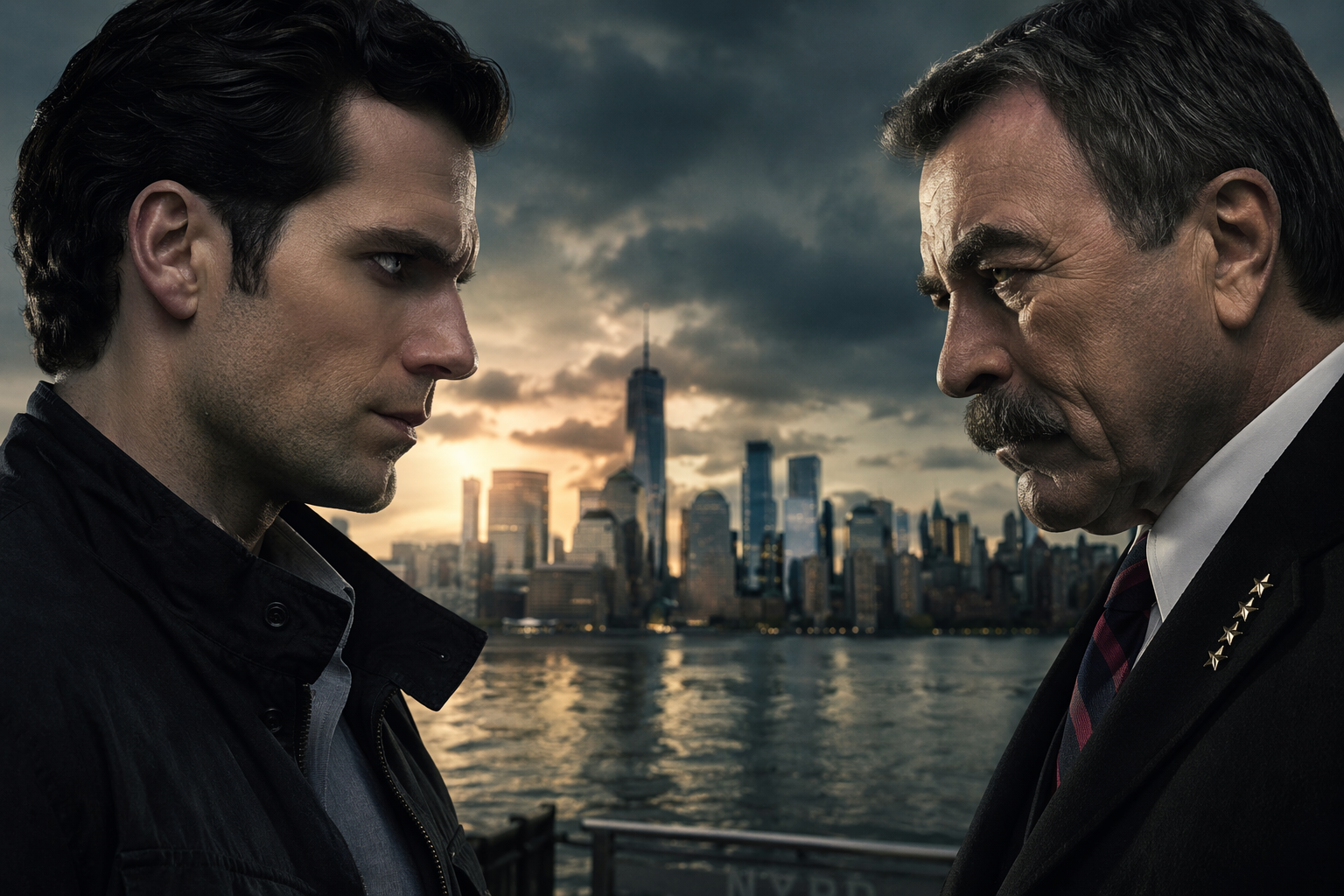
Even from short clips, it became clear that Frank Reagan and my own character, James Maguire, share a striking amount of DNA.

Both are straight shooters.

Both hold one of the most powerful positions in law enforcement, and yet, neither seems entirely comfortable with it. The rank is there, the authority is real, but there’s always a sense that they’d rather be doing the job than managing the politics around it.

And that’s where the tension lives.

Because neither man is built for politics.

They push back. They question. They resist when something doesn’t sit right. Not out of ego, but because they’ve spent their careers learning what justice actually looks like, not what it looks like on paper or in a press conference.

The Reality Behind the Badge

Here’s the part that resonates most with audiences, whether they realize it or not:

Both Maguire and Reagan were cops first.

They’ve seen things most people only read about. The ugliness. The randomness. The moments where there is no clean answer—only the least wrong one.

That experience changes you.

It strips away the illusion that everything is black and white. Because it isn’t.

It’s gray.

Always gray.

And yet, what makes these characters compelling is that they don’t abandon the idea of right and wrong, they just understand that sometimes you have to work within the gray to get there.

Why This Character Type Works

Here’s my take on why this archetype resonates so strongly:

People say they want clear lines: good versus bad, right versus wrong.

But deep down, they know that’s not how life works.

They understand that justice is complicated. That sometimes the system doesn’t function the way it should. That doing the right thing doesn’t always look clean or feel comfortable.

What they’re looking for—whether they realize it or not—is someone who can navigate those gray areas without losing their moral compass.

That’s where characters like Maguire and Reagan come in.

They’re not perfect. They’re not political animals. In many ways, they’re in roles they never would have chased, but once they’re there, they refuse to let the job change who they are.

They adapt just enough to survive the system… but not enough to be consumed by it.

The Reluctant Leader

At the end of the day, both James Maguire and Frank Reagan represent a type of leader we don’t see enough of—on screen or in real life.

The reluctant one.

The one who didn’t climb the ladder for power, but ended up at the top because they were the right person for the job.

The one who understands that leadership isn’t about control, it’s about responsibility.

And maybe that’s why these characters stick with us.

Because in a world full of noise, politics, and gray areas, there’s something reassuring about someone who can stand in the middle of it all and still say: “This is right. This is wrong. And I’m not backing down.”

If you’re a fan of grounded, character-driven crime stories—or if you’ve ever wondered what leadership really looks like behind the scenes—there’s a reason figures like these continue to resonate.

They remind us that even in the gray, integrity still matters.

When Snowballs Become a Warning: What Washington Square Park Says About the Collapse of Policing

Snowballs.

That’s what they were throwing at NYPD officers in Washington Square Park.

Not bullets.
Not Molotov cocktails.
Snowballs.

And that’s exactly the problem.

Because it wasn’t about snow.

It was about defiance.
It was about contempt.
It was about the open mockery of authority in a city that once understood what happens when order erodes.

I wore the uniform in the 80s, the 90s, and into the mid-2000s. The confrontational nature between cops and criminals — or even wayward youth — has always existed. That’s nothing new. But there used to be a line.

When you were told to move, you moved.

If you didn’t, you were making a choice. And that choice had consequences. Sometimes that meant what we used to call an “attention getter” — a sharp reminder with a nightstick that the conversation was over.

The police were either respected or feared.

In a civilized society, that balance is not cruelty. It’s necessity.

And like all necessary things, it requires discipline on both sides.

The Long Neutering of Law Enforcement

This didn’t happen overnight.

For more than a decade, policing in America — and especially in New York — has been steadily weakened. Public confidence shifted. The narrative changed. Police were cast broadly as the problem.

To be clear: no one despises a bad cop more than a good cop. Bad officers make the job exponentially harder. They stain the badge for everyone.

But something strange happened along the way.

Accountability became one-sided.

Where is the outrage for the behavior in Washington Square Park? Where is the collective condemnation of youths pelting officers with projectiles and laughing while doing it?

When did open defiance become entertainment?

Fear of Consequences Is Not Tyranny

As a Gen X kid growing up in the 70s, the rules were simple: if you did something stupid and got caught, consequences followed. Not theoretical consequences. Real ones.

You learned quickly.

And most people behaved — not because they were saints — but because they understood the cost of crossing the line.

Here’s the uncomfortable truth: humans are not inherently virtuous. The majority behave because there are laws — and because there are consequences for breaking them.

Remove the consequences, and you remove the restraint.

That’s not ideology. That’s history.

One quick example occurred outside a ‘social club’ which was slang for an organized crime location. This one was for the ‘yutes’ and we stopped to issue a ticket for a car parked in a bus stop. That was when the owner came out and started fighting with us, and then the rest of the club joined in. It started out as a 2 V 20+, but a radio changes the equation (and the odds) rapidly in NYC. Thirty seconds later, the night was filled with sirens and the cavalry coming with nightsticks. We got lumped up, but we won. One week later, and every VTL (traffic) infraction being enforced outside of every social club in the precinct, the ‘old men’ cried Mea Culpa, apologized, and dealt with their own. Lesson learned and we never had another problem.

The Slippery Slope No One Takes Seriously

People see officers getting pelted with snowballs and they laugh.

They scroll.

They shrug.

“It’s just kids.”

“It’s just snow.”

But what they’re witnessing isn’t weather. It’s erosion.

When there is no fear of consequences — or no respect for the enforcer of those consequences — the slide is fast.

Children raised without boundaries become adults who assume impunity. And when the police are no longer the target of that contempt, it doesn’t disappear.

It shifts.

Toward store owners.
Toward neighborhoods.
Toward you.

The Pendulum Always Swings Back

Society is a pendulum.

When it swings too far in one direction — stripping authority, mocking enforcement, tolerating disorder — it does not stop in the middle.

It swings back.

Hard.

History shows us this over and over. Periods of permissiveness often give way to periods of overcorrection. And when that swing comes, it rarely looks gentle.

The real question is this:

Will there be enough officers left willing to stand in the breach when it happens?

The Thin Blue Line Isn’t a Slogan

It’s a reality.

Most people don’t think about crime until it knocks on their own door. They’ll watch protests, riots, disorder — and assume it’s someone else’s problem.

Until it isn’t.

There was an old saying when I was on the job: nothing changes a liberal’s view on crime faster than becoming a victim of one. It’s human nature. We rarely care deeply about disorder until it touches us personally.

But by the time it does, the culture that once discouraged it may already be gone.

Snowballs Today. What Tomorrow?

Mockery of authority is not harmless. It’s a signal.

It signals that deterrence is fading.
It signals that consequences are uncertain.
It signals that enforcement is restrained while defiance is emboldened.

You can call it overreaction.

Or you can call it early warning.

Because when the line between order and chaos weakens long enough, it doesn’t quietly stabilize itself. It fractures.

And when it fractures, people don’t ask whether the officer being hit deserved it.

They ask why no one came when they called.

And maybe that’s the part that troubles me most.

Because I already wrote this ending once.

In my latest novel, Exposed King, the crisis eventually passes. The emergency fades. The outrage cools. And the people in power? They revert. The system resets. The lessons go unlearned.

The vigilantes were wrong in their methods — but their frustration wasn’t born in a vacuum. It was born from watching institutions hesitate.

From watching consequences soften.

From watching order become negotiable.

Washington Square Park isn’t about snowballs.

It’s about a society flirting with the idea that authority is optional and consequences are unfair.

In Exposed King, the most haunting realization wasn’t the chaos; it is what happens when good people are finally pushed too far.

We’re standing in that moment now.

And if we keep pretending snowballs are harmless — we may discover that the next thing thrown won’t be.

Publication Day: Exposed King

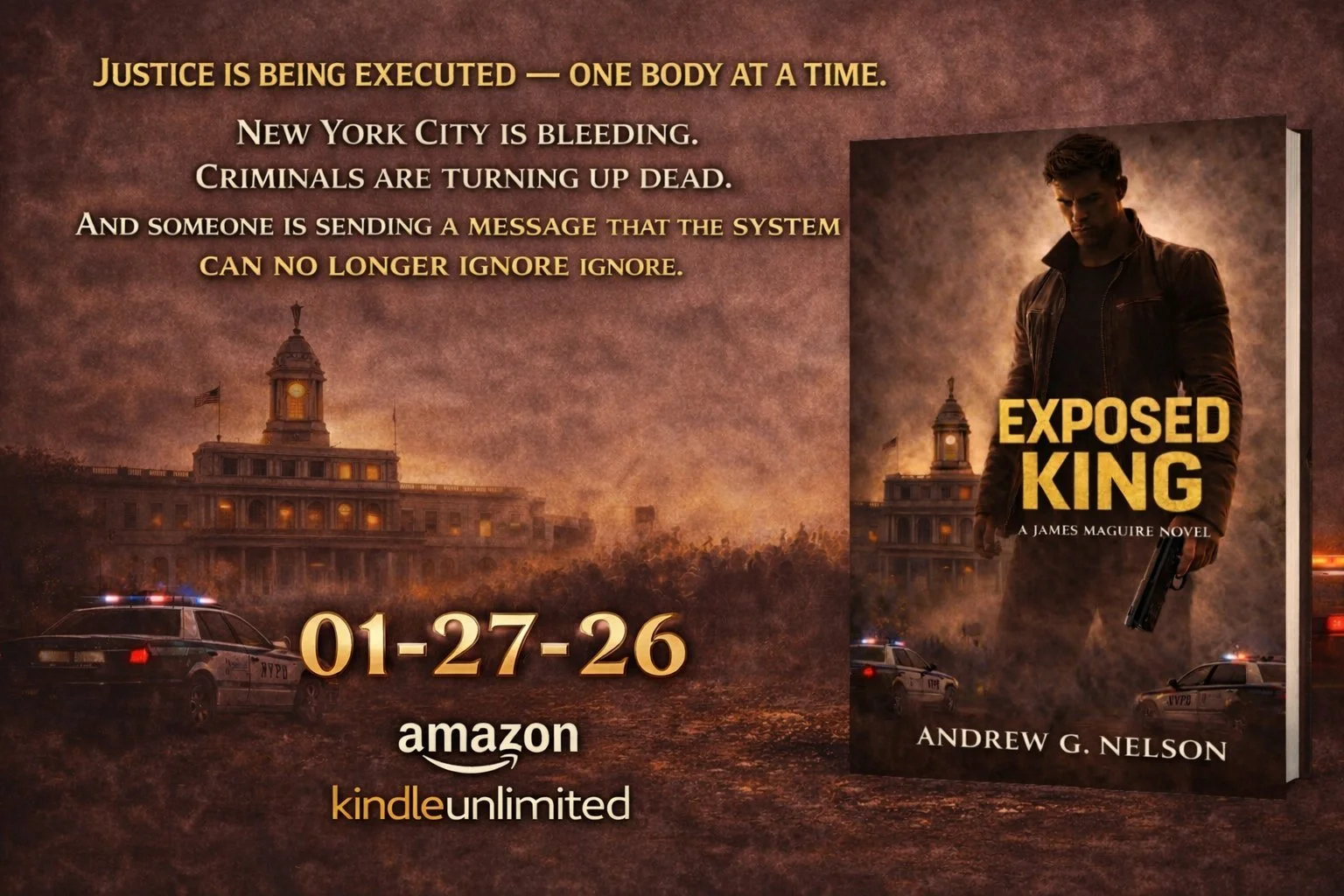
Today is publication day for Exposed King.

This novel has been a long time coming. What began as a crime thriller about a city under pressure evolved into a story that feels uncomfortably close to the world we’re living in now—where trust is fragile, power is protected, and justice is anything but simple.

Exposed King follows NYPD Commissioner James Maguire as New York City spirals. Criminals are turning up dead, fear is spreading, and someone is sending a message that the system can no longer ignore. As the lines between right and wrong blur, Maguire is forced to confront a question with no easy answer:
What happens when justice stops working?

The book is now live on Amazon Kindle, and I’m incredibly grateful to everyone who’s supported the James Maguire series along the way.

Thank you for reading.
The story is officially yours.

Pick up your copy of Expose King on Amazon today.

— Andrew G. Nelson

Exposed King Is Now Available for Kindle Pre-Order

I’m excited to announce that Exposed King, the next novel in the James Maguire series, is now available for pre-order on Amazon Kindle.

This story follows NYPD Commissioner James Maguire as New York City begins to unravel. Criminals are turning up dead. Fear is spreading. And somewhere in the chaos, someone is making it clear that the system no longer works the way it’s supposed to.

As pressure mounts, Maguire is forced to confront not just a growing body count, but the uncomfortable reality that justice—when filtered through politics, power, and public anger—rarely remains clean.

Exposed King was written as a crime thriller, but at its core it’s a question:
What happens when trust in the system collapses, and people decide the rules no longer apply?

If you enjoy gritty NYPD procedurals, morally complex characters, and stories that feel uncomfortably close to the real world, this one was written for you.

The Kindle edition is now live for pre-order on Amazon, with release coming soon.

Thank you to everyone who’s followed the James Maguire series so far. I can’t wait to put this one in your hands.

— Andrew G. Nelson