Frank Reagan & James Maguire: NYPD Blue Bloods vs Crime Fiction

I’m going to start this off with a confession that might surprise some people: I have never watched an episode of Blue Bloods.

That’s not a knock on the show. It’s actually self-preservation.

After 20 years as an NYPD officer, watching police dramas can feel less like entertainment and more like a critique session. I become that guy—the one sitting there pointing at the screen saying, “That’s not how it works,” or “There’s no way that would happen.” It takes the fun out of it for me and anyone unfortunate enough to be watching with me.

In fact, the closest I ever came to Blue Bloods for years was criticizing a photo of Tom Selleck in uniform, despite playing the Police Commissioner, which is a civilian position.

So no, I wasn’t exactly lining up to binge the show.

But then the internet did what the internet does.

At some point, Facebook decided I needed to start seeing Blue Bloods reels. I watched one. Then another. And suddenly, that’s all my feed became, which, to be fair, has been a lot more enjoyable than watching Mets highlight reels lately.

And that’s when something unexpected happened.

I started to notice a pattern.

Two Men, One Philosophy

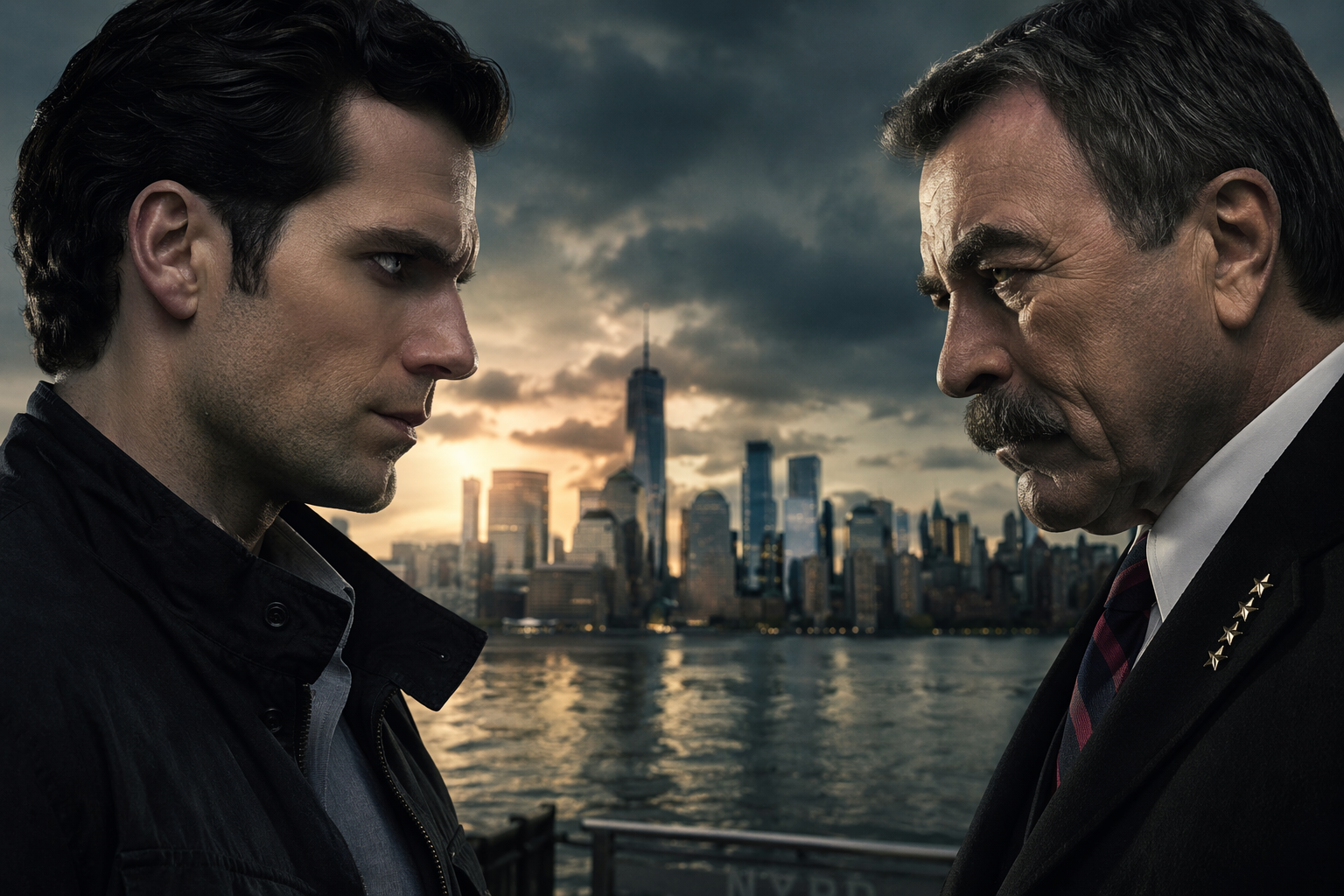
Even from short clips, it became clear that Frank Reagan and my own character, James Maguire, share a striking amount of DNA.

Both are straight shooters.

Both hold one of the most powerful positions in law enforcement, and yet, neither seems entirely comfortable with it. The rank is there, the authority is real, but there’s always a sense that they’d rather be doing the job than managing the politics around it.

And that’s where the tension lives.

Because neither man is built for politics.

They push back. They question. They resist when something doesn’t sit right. Not out of ego, but because they’ve spent their careers learning what justice actually looks like, not what it looks like on paper or in a press conference.

The Reality Behind the Badge

Here’s the part that resonates most with audiences, whether they realize it or not:

Both Maguire and Reagan were cops first.

They’ve seen things most people only read about. The ugliness. The randomness. The moments where there is no clean answer—only the least wrong one.

That experience changes you.

It strips away the illusion that everything is black and white. Because it isn’t.

It’s gray.

Always gray.

And yet, what makes these characters compelling is that they don’t abandon the idea of right and wrong, they just understand that sometimes you have to work within the gray to get there.

Why This Character Type Works

Here’s my take on why this archetype resonates so strongly:

People say they want clear lines: good versus bad, right versus wrong.

But deep down, they know that’s not how life works.

They understand that justice is complicated. That sometimes the system doesn’t function the way it should. That doing the right thing doesn’t always look clean or feel comfortable.

What they’re looking for—whether they realize it or not—is someone who can navigate those gray areas without losing their moral compass.

That’s where characters like Maguire and Reagan come in.

They’re not perfect. They’re not political animals. In many ways, they’re in roles they never would have chased, but once they’re there, they refuse to let the job change who they are.

They adapt just enough to survive the system… but not enough to be consumed by it.

The Reluctant Leader

At the end of the day, both James Maguire and Frank Reagan represent a type of leader we don’t see enough of—on screen or in real life.

The reluctant one.

The one who didn’t climb the ladder for power, but ended up at the top because they were the right person for the job.

The one who understands that leadership isn’t about control, it’s about responsibility.

And maybe that’s why these characters stick with us.

Because in a world full of noise, politics, and gray areas, there’s something reassuring about someone who can stand in the middle of it all and still say: “This is right. This is wrong. And I’m not backing down.”

If you’re a fan of grounded, character-driven crime stories—or if you’ve ever wondered what leadership really looks like behind the scenes—there’s a reason figures like these continue to resonate.

They remind us that even in the gray, integrity still matters.
Maybe We Need to Embrace Anarchy…

At least, that seems to be the direction we’re drifting toward.

It’s hard to come to any other conclusion when large segments of society have grown comfortable believing they can pick and choose which laws apply to them—obeying the ones they like, ignoring the ones they don’t, and demanding immunity from consequence when reality intrudes.

The participation-trophy mindset has matured into something more dangerous: the belief that discomfort equals injustice, that enforcement equals oppression, and that accountability is optional if you can frame yourself as morally aggrieved.

Laws as Suggestions, Consequences as Optional

We’ve quietly crossed a line where laws are no longer treated as the baseline rules of a shared society, but as personal recommendations—subject to individual approval. If a law aligns with your worldview, it’s righteous. If it doesn’t, it’s illegitimate. And if enforcement follows, the problem isn’t the violation—it’s the authority.

That logic doesn’t lead to reform.
It leads to erosion.

Because once laws become negotiable, they cease to function as laws at all. They become symbols—useful only for signaling, useless for order.

The Comfort of Chaos (Until It Isn’t)

Anarchy always sounds appealing to people who believe they’ll never be on the receiving end of it.

It feels liberating when rules dissolve and restraint disappears—when streets become stages for outrage and destruction is reframed as expression. But chaos has a way of shedding its romance quickly. It doesn’t stay targeted. It doesn’t remain selective. And it certainly doesn’t respect the moral intentions of those who invited it in.

Eventually, the same people who cheered the collapse of norms begin asking why no one is protecting them anymore.

By then, it’s too late.

Enforcement Isn’t the Problem—Inconsistency Is

What’s often missing from the conversation is this: most people don’t object to laws being enforced. They object to laws being enforced unevenly.

When leaders wink at defiance, excuse violations they agree with, and condemn enforcement they find politically inconvenient, they teach the public a dangerous lesson: rules are for suckers, and outrage is a shield.

That doesn’t create justice.
It creates resentment.

And resentment, left unchecked, always finds an outlet.

The Inevitable Endgame

If we truly want to “embrace anarchy,” then we should at least be honest about what that means. It means no referee. No shared rules. No neutral enforcement. Only power—who has it today, and who takes it tomorrow.

And history is brutally consistent on this point: when order collapses, it isn’t the idealists who thrive. It’s the ruthless.

The strong.
The organized.
The violent.

Everyone else learns—too late—why laws existed in the first place.

A Story, Not a Suggestion

These questions sit at the core of Exposed King, where a city pushed to excuse lawlessness discovers that chaos doesn’t stay contained. When people decide the system no longer deserves respect, someone always decides they deserve justice instead.

The novel isn’t an argument for anarchy.
It’s a warning about flirting with it.

Because once a society convinces itself that rules are optional, it shouldn’t be surprised when someone decides they are.

Publication Day: Exposed King

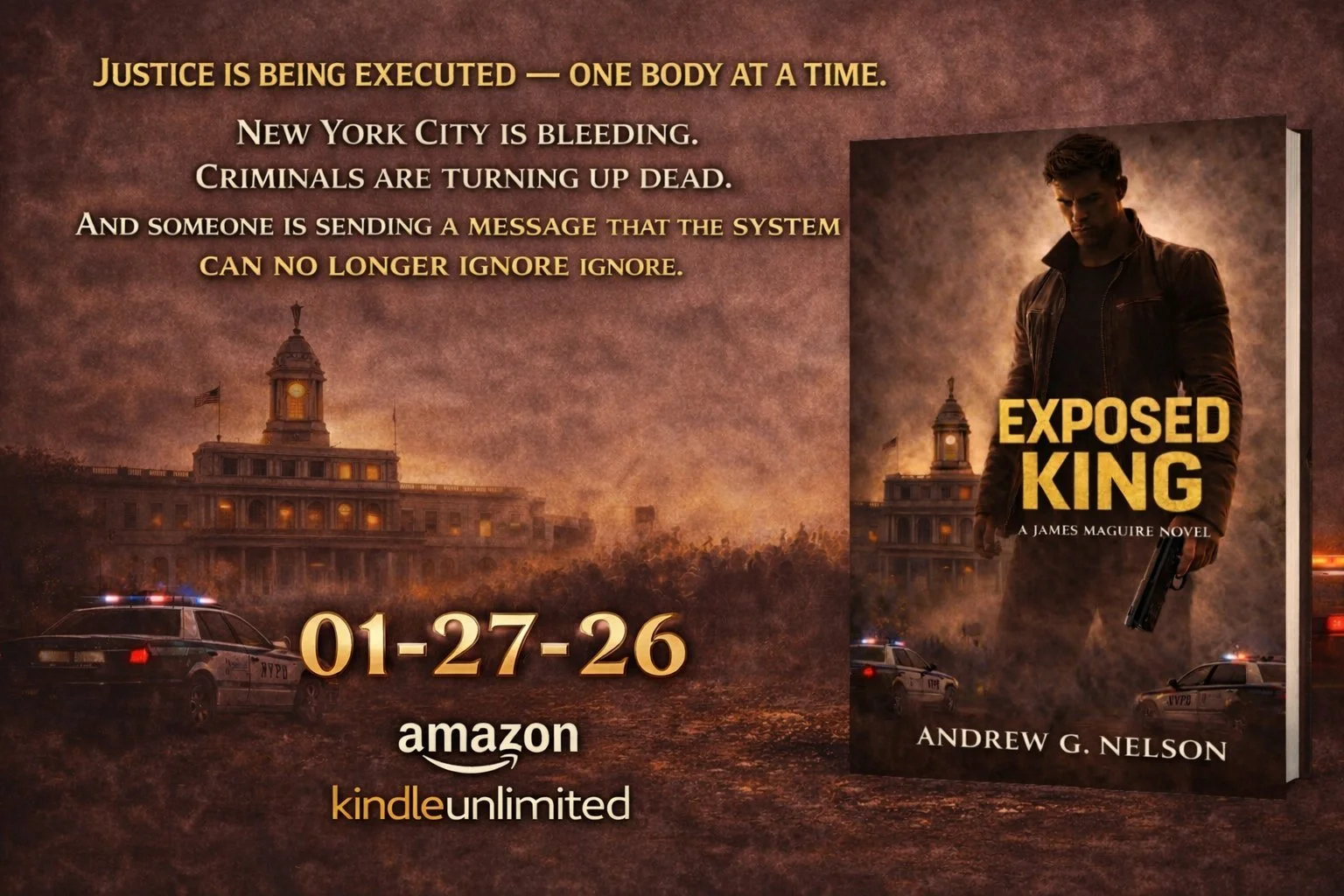
Today is publication day for Exposed King.

This novel has been a long time coming. What began as a crime thriller about a city under pressure evolved into a story that feels uncomfortably close to the world we’re living in now—where trust is fragile, power is protected, and justice is anything but simple.

Exposed King follows NYPD Commissioner James Maguire as New York City spirals. Criminals are turning up dead, fear is spreading, and someone is sending a message that the system can no longer ignore. As the lines between right and wrong blur, Maguire is forced to confront a question with no easy answer:
What happens when justice stops working?

The book is now live on Amazon Kindle, and I’m incredibly grateful to everyone who’s supported the James Maguire series along the way.

Thank you for reading.
The story is officially yours.

Pick up your copy of Expose King on Amazon today.

— Andrew G. Nelson

Exposed King Is Now Available for Kindle Pre-Order

I’m excited to announce that Exposed King, the next novel in the James Maguire series, is now available for pre-order on Amazon Kindle.

This story follows NYPD Commissioner James Maguire as New York City begins to unravel. Criminals are turning up dead. Fear is spreading. And somewhere in the chaos, someone is making it clear that the system no longer works the way it’s supposed to.

As pressure mounts, Maguire is forced to confront not just a growing body count, but the uncomfortable reality that justice—when filtered through politics, power, and public anger—rarely remains clean.

Exposed King was written as a crime thriller, but at its core it’s a question:
What happens when trust in the system collapses, and people decide the rules no longer apply?

If you enjoy gritty NYPD procedurals, morally complex characters, and stories that feel uncomfortably close to the real world, this one was written for you.

The Kindle edition is now live for pre-order on Amazon, with release coming soon.

Thank you to everyone who’s followed the James Maguire series so far. I can’t wait to put this one in your hands.

— Andrew G. Nelson

Cover Reveal: EXPOSED KING

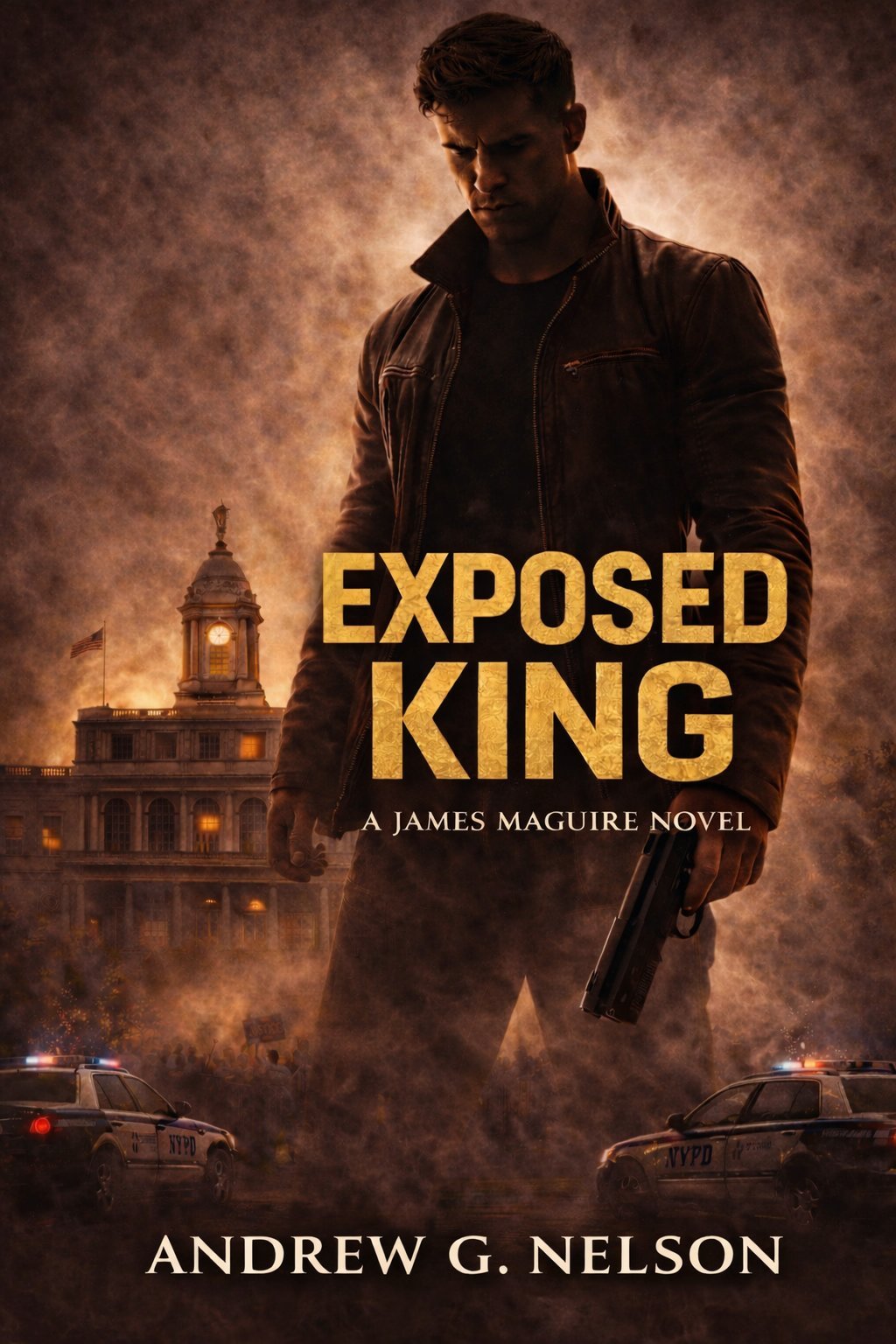
Today, I’m excited to officially reveal the cover for Exposed King, the next James Maguire novel.

I didn’t set out to write a book that mirrored the moment we’re living in—but sometimes fiction gets there first. Exposed King explores what happens when justice fractures, trust collapses, and a city is pushed to the edge. Today, I’m revealing the cover.

From the beginning, this story has been about pressure—on a city, on the justice system, and on the people sworn to uphold it. The cover reflects that tension: a city on edge, authority under siege, and a single figure standing at the center of it all.

Exposed King asks a simple but uncomfortable question: What happens when the system stops working—and people decide to take justice into their own hands?

This book was written before many of the events we’re witnessing now, but like the best crime fiction, it explores forces that never really go away: power, anger, corruption, and the consequences of pushing society too far.

The story is coming soon.
And so is the reckoning.