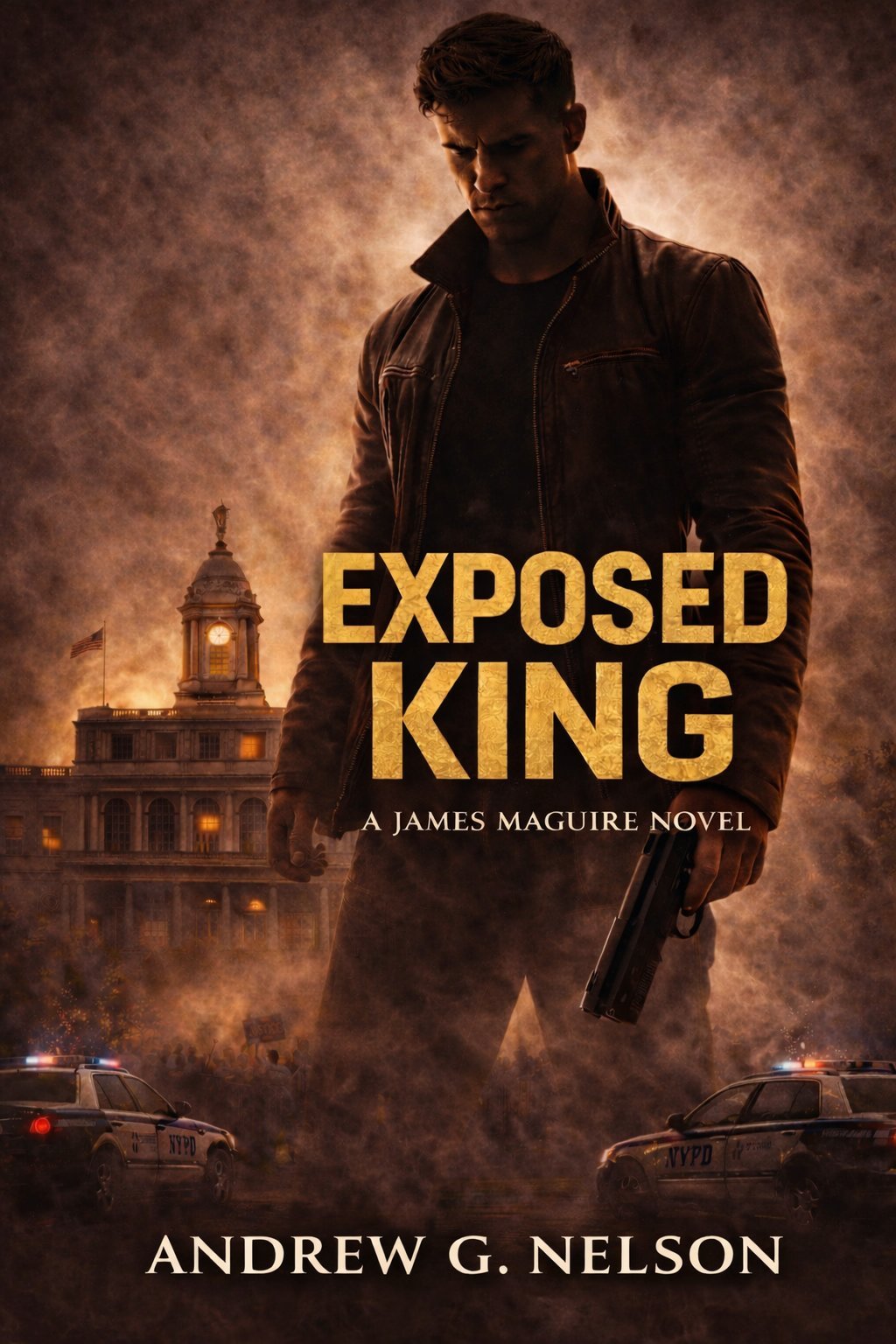
Cover Reveal: EXPOSED KING

Today, I’m excited to officially reveal the cover for Exposed King, the next James Maguire novel.

I didn’t set out to write a book that mirrored the moment we’re living in—but sometimes fiction gets there first. Exposed King explores what happens when justice fractures, trust collapses, and a city is pushed to the edge. Today, I’m revealing the cover.

From the beginning, this story has been about pressure—on a city, on the justice system, and on the people sworn to uphold it. The cover reflects that tension: a city on edge, authority under siege, and a single figure standing at the center of it all.

Exposed King asks a simple but uncomfortable question: What happens when the system stops working—and people decide to take justice into their own hands?

This book was written before many of the events we’re witnessing now, but like the best crime fiction, it explores forces that never really go away: power, anger, corruption, and the consequences of pushing society too far.

The story is coming soon.
And so is the reckoning.

When Fiction Bleeds Into Reality: A Cautionary Tale

There’s a moment every writer dreads—not writer’s block, not bad reviews—but the quiet realization that the story you’re telling no longer feels speculative.

It feels familiar.

As I prepare to release the latest James Maguire book, Exposed King, I’ve found myself increasingly unsettled by the daily news cycle. Headlines that once would have sounded exaggerated now feel routine. Language that once belonged in dystopian fiction is now spoken casually from podiums, press briefings, and social media feeds.

And that should concern all of us.

Writing a Story I Never Wanted to Be Relevant

Exposed King follows NYPD Police Commissioner James Maguire as he investigates a disturbing pattern: criminals turning up dead, seemingly targeted, seemingly judged, seemingly executed. The city is already fractured—politically, socially, morally—and instead of unifying in the face of fear, its leaders retreat into tribal lines, rhetoric, and blame.

Maguire isn’t just fighting a killer.
He’s fighting paralysis.
He’s fighting politics.
He’s fighting the slow erosion of trust between the public and the system meant to protect them.

I began outlining Exposed King in 2019—long before the social fabric felt this frayed, before institutions were openly questioned at every turn, and before division became a political currency. At the time, much of what I was writing felt speculative, even risky. I remember second-guessing certain plot points, worried that I might be “jumping the shark,” pushing the story too far beyond what readers would find believable. Now, as the book nears release, I find myself unsettled for an entirely different reason: those same elements no longer feel exaggerated. They feel plausible. Worse, they feel familiar—like stories that could comfortably lead the evening news rather than live between the covers of a novel.

That growing sense of recognition is also part of why Exposed King took longer to finish than I ever anticipated. As the world began to resemble the story I was trying to tell, I found myself slowing down—not because I had run out of ideas, but because the line between fiction and reality had blurred. The story demanded more care, more restraint, and a deeper understanding of the consequences it was pointing toward.

Exposed King was intended as a cautionary thriller—a “what if.” What if leaders spent more time posturing than protecting? What if laws were enforced selectively? What if criminals were elevated as symbols while ordinary civilians were reduced to statistics? What if accountability vanished, replaced by ideology?

I never expected to watch those questions unfold in real time.

The Dangerous Game of Anarcho-Tyranny

There’s a concept often discussed in political theory called anarcho-tyranny: the idea that institutions grow increasingly oppressive toward the law-abiding while becoming increasingly permissive toward the lawless.

You see it when:

  • Crime rises, but consequences vanish

  • Civilians are told to “understand” while victims are told to endure

  • Violence is condemned selectively, depending on who commits it

  • Entire groups of people are demonized for their beliefs, their votes, or their skin color

When leaders fan these flames—intentionally or not—they gamble with something they cannot control: human breaking points.

History shows us, again and again, that when good people feel abandoned, ignored, or sacrificed for political optics, something snaps. Not in everyone. Not at once. But enough to change the trajectory of a society.

That’s the danger zone.

When the System Loses Moral Authority

One of the central tensions in Exposed King is this:
What happens when the system loses the moral authority to govern?

Not legally.
Morally.

When people no longer believe justice is possible, they don’t stop believing in justice altogether—they start redefining it. And that’s when things turn dark.

This isn’t an endorsement of vigilantism. Quite the opposite. It’s a warning. A society that pushes its citizens into corners—where law feels optional for some and suffocating for others—creates the very monsters it later claims to fear.

And here’s the part that should keep politicians awake at night:

Once violence becomes normalized, once dehumanization becomes routine, once “enemy” replaces “neighbor,” the crosshairs don’t stay fixed on the margins forever.

They move.

A Personal Unease

As a writer, I’m supposed to imagine worst-case scenarios. I’m supposed to explore uncomfortable questions. But I never wanted to feel like I was chronicling the present.

There’s a deep discomfort in watching scenes I labored over—conflict, distrust, political theater—play out not on the page, but in real cities, with real victims, and irreversible consequences.

Stories are meant to provoke thought, not serve as blueprints.

A Caution, Not a Call

Exposed King is not a manifesto. It’s not an argument for one side or another. It’s a warning about trajectories—about what happens when leadership prioritizes ideology over stability, messaging over lives, and division over responsibility.

The path we’re on is a dangerous one.

If leaders continue to sacrifice cohesion for applause, morality for momentum, and people for power, they shouldn’t be shocked when the consequences arrive uninvited.

Because once society decides the rules no longer apply evenly… everyone becomes vulnerable.

Including those who thought they were untouchable.

September 11th, Charlie Kirk, and Exposed King

I am sitting here this morning feeling a sense of numbness as I deal with the normal emotions of September 11th coupled with the assassination of Charlie Kirk. I say ‘normal’ because as an NYPD first responder on that day I have grudgingly accepted that the emotions are part of who I am now. I stopped trying to make sense of it long ago, and now I just accept that there is an ebb and flow that I must ride out annually. I don’t fight it; I just let the memories come in and go out, because you cannot make ‘sense’ of what happened twenty-four years ago.

On September 11th, 2001, we came together as a country. At first we felt rage and anger about the terrorist attack. Then we felt the collective pain as we came to terms with the fact that we’d lost thousands of our fellow citizens; men, women and children who would never see another sunrise; people who woke up and died because of someone else’s hatred. Then there was a brief moment of solidarity: United We Stand, Never Forget, Remember the Heroes… but like most altruistic slogans, it had no depth.

Yesterday, September 10th, 2025, a 31-year-old husband and father of two small children was assassinated in Utah. His crime? Having a dissenting opinion.

Charlie Kirk was on a university campus, a world where dissenting opinions have traditionally been fostered and embraced, but yesterday we were told, in no uncertain terms, that this world no longer exists.

A man was murdered in cold-blood and many cheered at his demise.

A bullet became the ultimate form of censorship.

It reminded me of the line spoken by Tyrion Lannister in George R.R. Martin’s book: Clash of Kings – “When you tear out a man's tongue, you are not proving him a liar, you're only telling the world that you fear what he might say.”

This is America now. This is who we have become. Not United, but divided to the point that murder has become an acceptable course of action against those whom we disagree with.

I released my last James Maguire book, Glass Castle, in 2019. As most good authors, I had the working plot for the next book, Exposed King, in my head. I remember that I struggled a bit with it, because it had what I felt was a radical leap, or, to use the old Happy Days trope, I felt like I was ‘jumping the shark’ with this story-line, but I told myself that I could polish it and make it plausible. I’d moved on to the next Alex Taylor book, The Killing Game, as I compiled notes and ideas and fleshed-out the outline.

Then Covid-19 happened.

I thought it was my time to shine, to get the downtime I needed to write my little heart out.

I finished The Killing Game, I wrote Awakening, a genre bending police procedural meets vampires, got in another Cold Case novella, and even managed to write: Shadow Strike, a Maguire origin story, but Exposed King languished in a file on my computer.

I wrote some chapters, which were more like snippets or frustrated paragraphs, in fits and starts, struggling as I went, as if some unseen force was trying to block me. As a writer, I knew I had to walk away. Forcing it would never work. I kept asking myself why I was having so much of a problem.

It’s fiction. I’m a writer. This is what I do.

The truth is I fear that Exposed King won’t be fiction. The premise is less of a ‘who done it’ and more of a ‘what if.’

As I said earlier, the plot came to me during Glass Castle, pre-dating Covid, but also George Floyd and before the Defund the Police movement and all the other radical events since. With each passing day, I saw my fictional plot growing potentially more real, and it scared me.

America is changing, and not for the better.

For nearly a hundred years, Superman’s iconic motto was: “Truth, Justice, and the American Way,” and yet today we find ourselves facing an America where truth is subjective, justice is no longer impartial, and the American way is abhorrent to a large swath of society.

I know I have to finish Exposed King; I just hope it remains within the realm of fictional work and does not become a prescient warning.

A part of me wonders if George Orwell felt the same way when he published 1984.

May God have mercy on us.

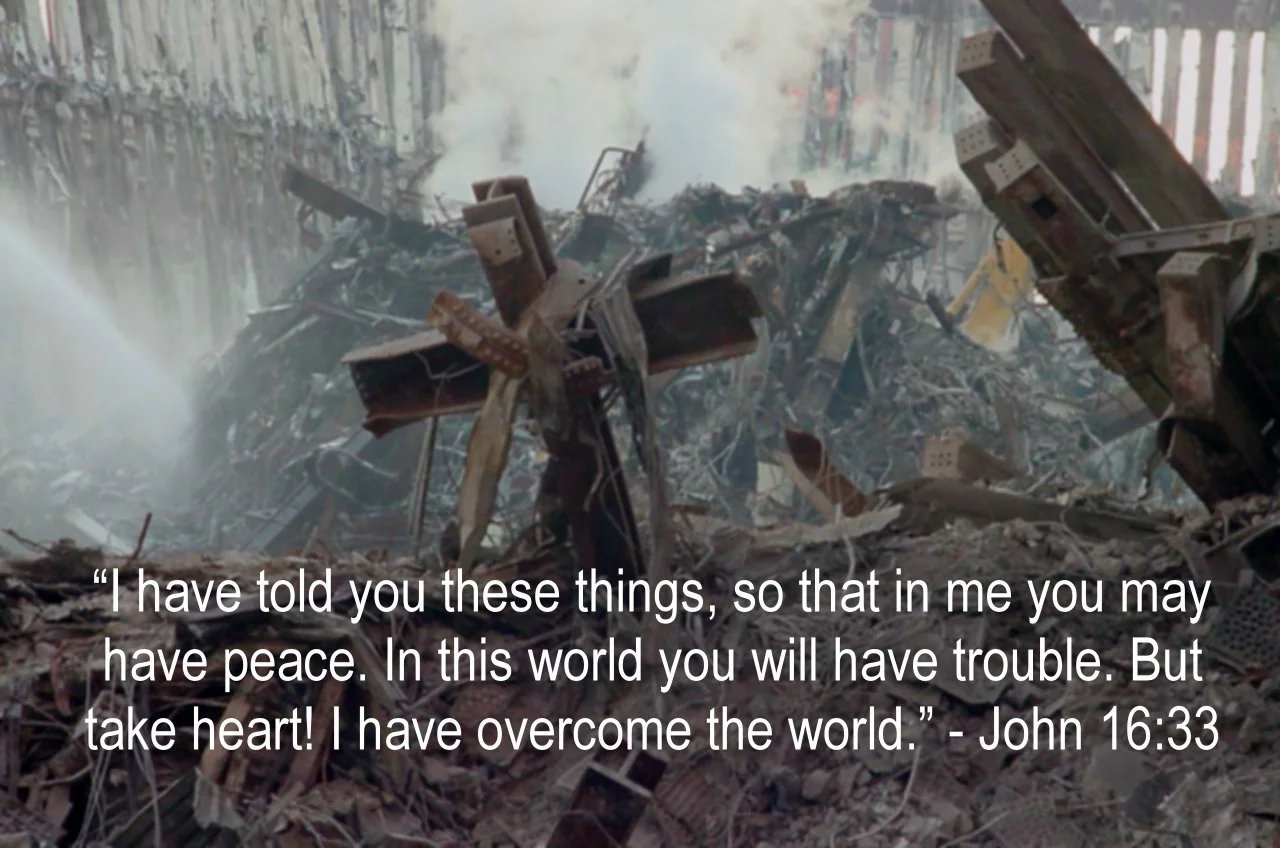
9/11 World Trade Center Cross taken by anne bybee

Challenges for Writers: Overcoming Literary Hurdles (Reviews)

Do you remember where you were when you first learned there were over seven million books in the Amazon Kindle Store? Hopefully it wasn’t just a moment ago.

It’s a staggering number, especially when you are about to release your first book. Hell, let’s be honest, it’s staggering even if you’re releasing your fiftieth book, but as difficult as it might seem, there are ways for you to reduce that number.

My writing career officially began in 2012, when I sat down and began work on my first mystery novel, Perfect Pawn, but its foundation dates back to a conversation I had with my wife in 2001. I’m glad I didn’t know back then the extent of the daunting road that lay ahead for me. As I mentioned last week, I have authored a total of ten books, along with two novellas, and I am currently writing my latest work-in-progress. During that time I have done a lot of things right, but an even greater amount of things wrong.

As an up and coming author, you need to accept that when you put the proverbially: The End, on your book, it is a lie. It would be nice if it was true, but that’s just not reality. Your job as an indie author is more like that of a general contractor.  Now that the foundation is complete, you have to focus on getting the rest of the job finished.

If you read last week’s post: Challenges For Writers, maybe you decided that cover design, editing and formatting just isn’t your thing. I can’t find fault with that thinking because not everyone has the time or the background to undertake those tasks. Most indie authors have full time jobs, so focusing on writing when you can, and outsourcing the other stuff, is probably the best option. But there are things beyond those critical issues that you will also need to address.

For the most part, when authors such as James Patterson, Lee Child, or J.D. Robb finish a book they do a lateral pass and their publishing houses take over. As an indie author, you are that publishing house. This means that if you want to effectively compete against those seven million other books on the market you are going to have to do some heavy lifting for yourself. This is where the proverbial rubber hits the road. I would love to be able to tell you what to do, but as I previously mentioned, I am still learning as well. I can only give you advice about what hasn’t worked for me.  At the end of the day, it doesn’t matter what everyone else is doing, all that matters is what you are doing.

I’d originally wanted to address several topics in this post, but I realized it was getting a bit long. So I decided to address them individually. This week I am going to touch on the topic of Reviews. In the upcoming weeks I will talk such issues as: Social Media, Publicity, Stagnant Sales, Keywords and Ads.

Begging for Reviews – Go on Amazon and look at your nearest competitor and marvel at the astronomical review numbers they have. All of a sudden that concept of ‘redistribution of wealth’ begins to sound a lot more palatable. I’d be happy to take a few of Patterson’s reviews off his hands.

Damn you, James Patterson………………

Damn you, James Patterson………………

Once you start to compare your numbers against theirs its hard not to get bummed out. Hell, you might even begin to wonder if your own mother hates you. I mean, she still hasn’t written a review for you and you gave her that free book years ago. Trust me, you’re not alone.  I can’t begin to tell you the number of free books I have given out to family and friends over the years, but I can tell you the number of reviews that it has generated; which coincidentally is the same number of Super Bowl appearances by the Detroit Lions: ZERO.

Let’s be honest, reviews are really important to authors for a variety of reasons, including:

1) Writing books is a really poor way to make a living, unless you enjoy a regular diet of ramen noodles and tap water, and reviews are your only source of literary validation

2) They factor into the algorithms that sellers like Amazon use when they recommend books to others

But are they worth the time and effort you put into trying to generate them? Sadly, the answer is no, at least not from your inner circle. If you are interested, I have written a more in-depth examination regarding the problem that authors face, in terms of reviews, here: The Labyrinthian World of (Fake) Book Reviews

Since that article, I have reached the conclusion that it is just not worth the effort, at least when it comes to your inner circle. Here is my advice to you: Stop asking and if you feel like giving a book away for free, do it without any thought that you will get a review. You’ll save yourself from a lot of disappointment.

Your focus should be generating enough sales of your book(s) from other sources that will lead to organic reviews. What you (and potential readers) want to see on your Amazon Review page are the ones listed as: Verified Purchase. This means that the review is an organic one from someone who purchased it through Amazon. You know who also likes it? Amazon and their algorithms.

Beyond that, are the reviews by folks listed as: #1 REVIEWER, TOP 10 REVIEWER, TOP 50 REVIEWER, TOP 100 REVIEWER, TOP 500 REVIEWER, TOP 1000 REVIEWER, HALL OF FAME REVIEWER. Next to the aforementioned James Patterson endorsing your book, nothing says ‘buy me’ more than a review from an established Amazon Reviewer.

That being said, you want those reviews to be 4 & 5 stars, so it behooves you to make sure your book is the best it can be when you publish it.   

Next up I will be discussing the topic of Social Media.

Please remember to sign-up for my FREE Newsletter to stay up to date on the latest information.

IN THE BEGINNING

wtc_color3.jpg

Welcome to my brand new Website & Blog.

Over the years I have had a number of different homes on the web; places where I was able to share my thoughts, ideas, and opinions on juts about everything (Hey, I am a New York'er after all). Eventually, this desire to write, coupled with my wife's constant prodding, morphed into my present role as an author. 

Sometimes it is interesting to go back and look at the early days, prior to the release of my first novel, and see how things progressed. For posterity reasons I am linking the former Blog: A new York City state of mind, in the event that anyone wants to check things out. 

BLOG LINKhttp://andrewgnelson.blogspot.com/